![AVS [Actively Validated Services]](https://imagedelivery.net/IEMzXmjRvW0g933AN5ejrA/wwwnotionso-image-prod-files-secures3us-west-2amazonawscom-18664812-e45a-49f6-af50-c7c6347a4f3c-8c8331d8-81ec-4ad4-83b4-70f09bc8f9b9-black-dot-removebg-preview_1png/public)
What is a Restaking AVS?
An Actively Validated Service (AVS) refers to any protocol that employs its own decentralized validation mechanism. This can include systems like rollups, sidechains, or decentralized price oracle networks.
The primary advantage of becoming an AVS lies in the ease, cost-effectiveness, rapid bootstrapping, and enhanced security that protocols can attain. This is in contrast to the traditional method, where protocols need to create their own security by issuing tokens to incentivize validators.
Take, for instance, a decentralized RPC provider. This provider developed a decentralized method for submitting RPC nodes, allowing for the use of decentralized RPC endpoints. However, before focusing on its main goal, it had to establish a decentralized validator set named Blast. If this decentralized RPC provider had been developed as an AVS on EigenLayer, it could have avoided this costly and time-consuming process by utilizing Ethereum’s existing and highly decentralized validator network. This would have enabled the provider to concentrate its resources on its core mission, saving time and money while achieving better security.
Database of Top Restaking AVSs
Top Restaking AVS
AVS
Description
AVS Category
Website

Twitter/X

Unmatched speed and privacy with zkRollup Framework.
Rollup Services
Cryptography
Data Availability
Enhancing blockchain interoperability with seamless layer solutions.
Interoperability
Data Availability


Launchpad for customizable chains using Arbitrum technology.
Rollup Services
Data Availability
ZK coprocessor that enables smart contracts to access historical on-chain data and run customizable, trust-free computations.
Coprocessors
Proofs
Data




Reputation & credibility for crypto, driven by peer-to-peer reviews & secured by staked ETH
DeFi




Nodekit is the composability layer that unlocks synchronous communication between blockchains.
Interoperability
Low latency interoperability network that connects all Ethereum rollups securely through the use of restaking.
Interoperability
Standardized, shared, and open-source development stack that powers Optimism.
Cryptography
Rollup Services
Opacity is a zkTLS based AVS for trustlessly bridging web2 data to web3.
Coprocessors
Interoperability

Polyhedra unlocks ZK for AI, machine learning, interoperability, gaming, and TradFi at scale.


Watchtower network using restaking for Proof of Diligence and ensuring rollup security, as well as for Proof of Location.
Proofs
ZK-powered layer 2 network that connects the OKX and Ethereum communities.
Data Availability
Interoperability


Distributed Validator Technology for secure, decentralized, and scalable staking infrastructure
Proofs
Cryptography
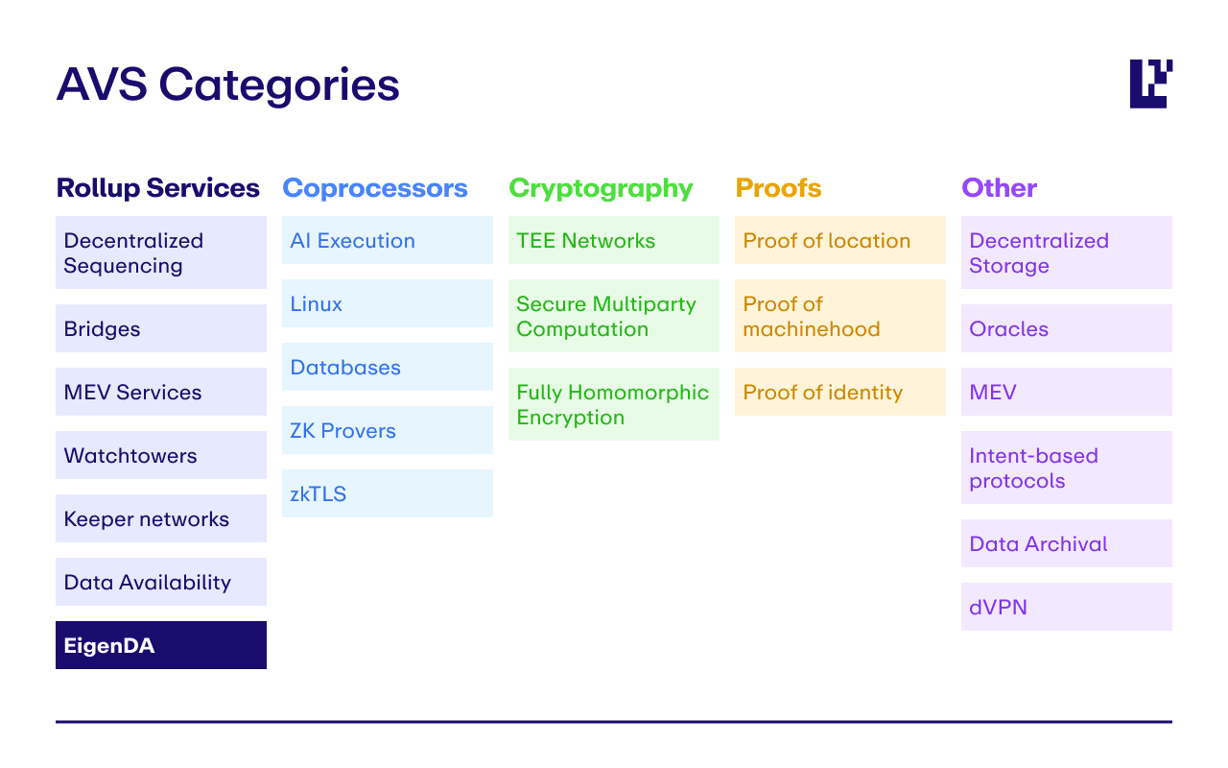
Popular Use Cases of AVSs
- New Chains: Developers can create new blockchains by using core primitives from the AVS modules, such as intersubjective staking, which provides decentralized assurance for the new chain’s components, including consensus and validation mechanisms.
- Composable Blockchain Modules: Complex blockchain architectures can be built by combining modules that serve specific purposes, such as validity checking (using zero-knowledge proofs or cryptoeconomic methods), censorship-resistant transaction ordering, data availability, block proposer auctions, and finalization services to ensure resistance against chain reorganizations.
- Intents, Order Matching, and MEV Engines: AVSs facilitate innovations in matching off-chain intents with on-chain transactions, especially in complex validation environments where slashing contracts may not be easily defined. Intersubjective staking supports such systems by offering security against failure points.
- Databases: For execution environments where proving the validity of computations (via fraud proofs or validity proofs) is challenging, intersubjective slashing can act as an intermediary solution to secure databases until more rigid slashing protocols are developed.
- Gaming Virtual Machines (VMs): In gaming, where state transitions involve complex GPU computations and non-deterministic elements, AVS can help by providing intersubjective attribution of significant violations in game states, ensuring fair gameplay.
- AI Systems: AVS can be applied to AI systems that lack full determinism due to floating-point arithmetic or non-determinism in their computations. By leveraging intersubjective slashing, violations in AI training, benchmarking, or inference can be attributed based on precommitted code and hardware architecture.
- Prediction Markets: Oracles in prediction markets are critical for resolving outcomes. By integrating intersubjective staking into these oracles, the markets can operate in a more decentralized and permissionless manner, ensuring trust in the outcome resolution.
- Storage Services: New storage protocols can be created using proof-of-replication or proof-of-custody mechanisms. If nodes fail to maintain distinct units of data, they can be slashed through an intersubjective slashing protocol, enhancing the security of decentralized storage.
- Cloud Microservices: Cloud services like Apache Kafka, which are composed of compute, network, and storage, can be adapted into blockchain versions with AVS modules. By adding intersubjective slashing, these microservices can become verifiable and decentralized.