What is Solayer?
Solayer is a prominent restaking marketplace on the Solana blockchain, designed to enhance the performance and security of on-chain decentralized applications (dApps) by improving network bandwidth and securing the Layer 1 (L1) base. The platform facilitates the provisioning of block space and prioritization of transaction inclusion, allowing dApps a greater chance of being processed efficiently.
Key Features
- Restaking Mechanism: Solayer operates by utilizing staked SOL tokens to enhance the quality of service (QoS) for dApps. Higher stake weight leads to a greater likelihood of securing block space and prioritizing transactions. This system is similar to a marketplace where resources like block space and transaction throughput are allocated based on the amount of stake. Users can participate in Solayer’s marketplace by staking native Solana tokens and receiving sSOL, the Liquid Restaking Token. This LRT can be restaked to earn additional rewards. Users can also stake Liquid Staking Tokens (LSTs) from partner protocols like Marinade (mSOL), Jito (JitoSOL), BlazeStake (bSOL), and Sanctum (INF).
- Stake-Weighted Quality of Service (QoS): The platform offers a stake-weighted QoS, similar to a VIP pass, where validators with more stake can process more transactions, ensuring higher performance and security for applications. This model helps mitigate malicious activities and provides a better user experience for those with more significant stakes.
- Market Dynamics: Solayer functions similarly to a cloud service marketplace, where stakers (supply side) provide stake, and applications (demand side) require block space and transaction throughput. Validators act as facilitators in this ecosystem.
- User Onboarding: To participate, users must connect their SVM wallet and social media accounts. The platform also offers a unique referral system for gaining additional participants. Users can manage their staking activities, including deposits and withdrawals, through the platform’s user-friendly interface.
The Solayer Architecture
Solayer is a restaking marketplace built on the Solana blockchain, focusing on enhancing the security and efficiency of decentralized applications (dApps) and the Solana network. The architecture of Solayer revolves around several core components:
- Restaking Mechanism: Solayer enables users to restake their tokens, such as native SOL or Liquid Staked Tokens (LSTs) from partner protocols like Marinade, Jito, BlazeStake, and Sanctum. When users stake SOL, they receive an sSOL-raw token, which is then restaked to generate sSOL, the Liquid Restaked Token (LRT) of Solayer. This restaking process allows users to earn rewards and participate in securing both endogenous (on-chain) and exogenous (off-chain) Actively Validated Services (AVSs).
- Quality of Service (QoS): Solayer provides a stake-weighted QoS infrastructure, ensuring that applications can access reliable and prioritized network resources. This service is particularly valuable for dApps needing consistent performance and low latency.
- sSOL and LRT: The sSOL token is a representation of staked SOL within Solayer. It can be used within the Solana DeFi ecosystem, providing liquidity and earning additional yields. LRTs, issued based on the type of LST restaked, offer users a way to participate in various staking and reward mechanisms.
- Security and Privacy: Solayer utilizes a decentralized network of validators, promoting a secure and trustless environment. The protocol's design ensures that validators and delegators are economically incentivized, with shared security guarantees for new networks leveraging Solayer's infrastructure.
- Governance and Flexibility: Solayer allows for a flexible governance system, enabling module developers to manage risks and select acceptable tokens for restaking. This flexibility ensures that the protocol can adapt to the needs of different dApps and services.
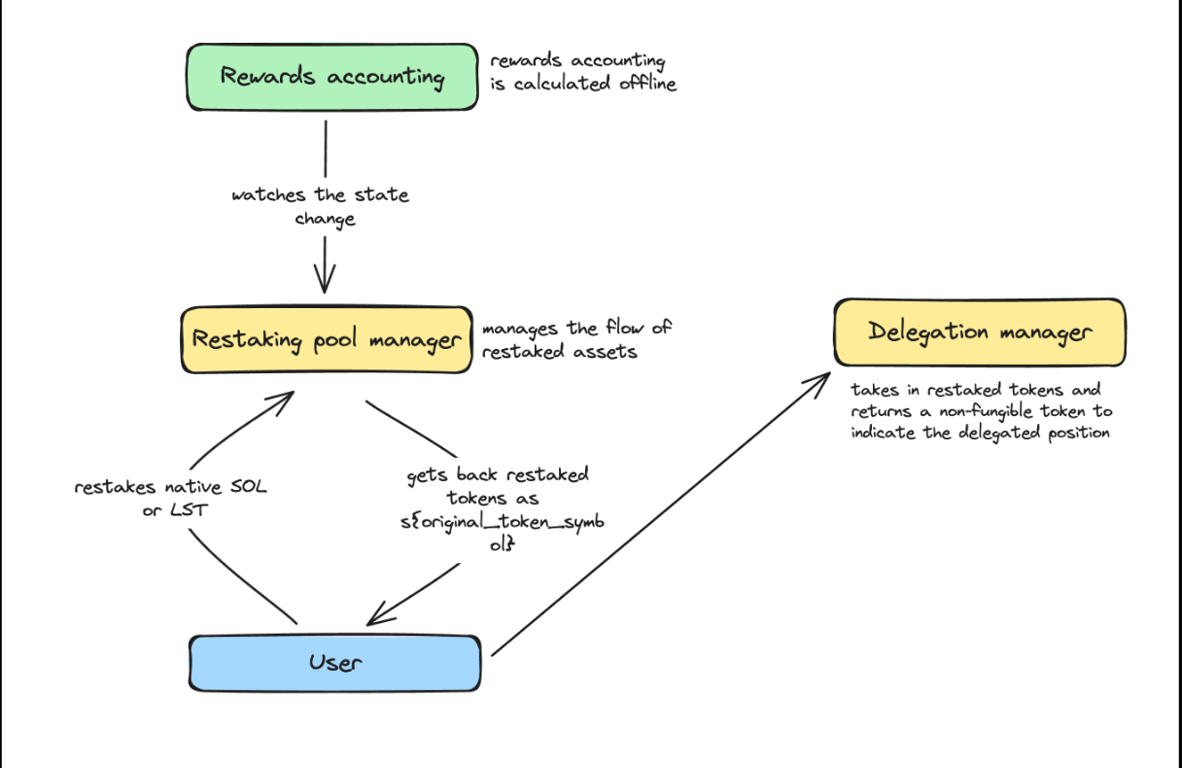
How does Restaking Work on Solayer?
Restaking on Solayer involves leveraging various assets to secure and enhance the Solana network while providing additional benefits to users. Here's an overview of how it works:
- Restaking Pool Manager: Users can deposit Liquid Staking Tokens (LSTs) or SOL into the restaking pool. These assets are then converted into a fungible token representation known as "Solayer assets." Although currently illiquid, these assets will become liquid in future developments to enable composability with DeFi protocols.
- Restaking Options: Users can restake SOL, which is first converted into a native token called sSOL. Likewise, Users can deposit various LSTs, such as mSOL, JitoSOL, bSOL, or INF, into Solayer's contracts, effectively restaking them.
- Delegation: Users can delegate their Solayer assets to specific node operators, known as Solayer Verification Nodes (SVNs), to secure additional networks. This delegation is crucial for managing validation nodes for Actively Validated Services (AVS) within the ecosystem.
- Non-Fungible Tokens (NFTs): When users delegate their assets, they receive a unique NFT that represents their restaking portfolio. This NFT encapsulates the risks and rewards associated with the chosen node operators and AVS, making it non-fungible.
- Rewards and Security: Rewards are calculated and distributed based on deposits, withdrawals, and invite relationship data. Additionally, Solayer includes mechanisms to manage risks, such as slashing penalties for operators engaging in malicious behavior. Users can also use an emergency exit mechanism to release their staked assets if needed.
- Permissioned Restake Method: The restake method requires an additional server signature for security, particularly in early epochs, to enforce deposit limits. The unstake method does not have this requirement, allowing for more straightforward asset withdrawal.
Overview of Solayer’s Restaking/Liquid Restaking Token —  sSOL
sSOL
- Liquidity and Blockspace Allocation: sSOL represents a unit of blockspace on the Solana network, effectively lent towards dApps to secure network bandwidth and Transactions Per Second (TPS). This mechanism ensures that dApps have prioritized access to the network's resources.
- Integration with AVS SPL Tokens: Delegated stakes towards dApps generate AVS (Actively Validated Services) SPL tokens. These tokens are built on the liquidity provided by sSOL and SOL. This integration allows for a seamless and efficient delegation process, ensuring the security and functionality of AVS within the Solayer ecosystem.
- Interface for LRTs: LRTs, which are a form of derivative tokens representing staked assets, are also built on top of the sSOL liquidity interface. This design enables the generation of various vault strategies, allowing users to maximize yield through diverse financial mechanisms.
- Yield Generation: sSOL holders can earn yield in multiple ways. They can delegate their sSOL to dApps to bootstrap network bandwidth, thereby earning staking rewards. Additionally, holders can participate in various DeFi strategies offered by Solayer's launch partners, potentially earning additional Annual Percentage Yields (APYs).
Use Cases and Benefits
- Delegation to dApps: Users can delegate their sSOL to specific dApps, supporting their operation and earning a share of the rewards.
- Participation in DeFi: Beyond staking, sSOL can be utilized in various DeFi protocols, enhancing liquidity and offering additional earning opportunities.


