
What is Swell Liquid Restaking?
Swell is an innovative, non-custodial staking protocol designed to revolutionize the experience of liquid staking and restaking in the Ethereum ecosystem. Its mission is to provide users with a top-tier staking solution that not only simplifies access to decentralized finance (DeFi) but also contributes to the security and efficiency of Ethereum's network and restaking services.
Core Features of Swell Liquid Restaking
Swell offers several advantages that make it a compelling choice for users:
- Enhanced Yields: By combining staking yields with DeFi opportunities through a single interface, Swell maximizes the earning potential for users.
- Lower Fees: Swell charges a relatively low fee of 10% on staking, compared to the typical 4% average ETH staking annual percentage yield (APY). This makes it a cost-effective option for users.
- No Minimum Stake Requirement: Unlike traditional staking, which requires a 32 ETH deposit, Swell allows users to start staking with a minimal amount of ETH, making it accessible to a broader audience.
- Self-Custody: Users retain full control of their assets in their own wallets. This approach reduces the risk associated with custodial platforms, where users may face total losses if the platform misuses funds or becomes insolvent.
- Security Focus: Swell emphasizes security through continuous auditing by leading blockchain security firms and relies on a vetted group of professional node operators to manage staking pools effectively.
- Tax Efficiency: Swell’s swETH and rswETH are designed to be reward-bearing tokens rather than rebasing tokens. This design choice helps avoid the creation of potentially taxable transactions and reduces the risk of being taxed twice—once when receiving the crypto and again when selling it.
The Swell Liquid Restaking Architecture
- Polygon Chain Development Kit (CDK): The Polygon CDK is a modular, open-source software toolkit designed to help developers efficiently launch Layer 2 (L2) chains on Ethereum. It distinguishes itself by not extracting fees from sequencer operations on chains built using the CDK, unlike other solutions such as Optimism Superchain. The CDK focuses on network effects through proof aggregation, which facilitates fast and secure bridging and unifies liquidity across chains.
- Swell’s Ecosystem Flow: In the Swell ecosystem, rswETH secures AVSs (actively validated services), which in turn provide yield and infrastructure to Swell L2. Revenue generated from AVSs is reinvested into rswETH, enhancing liquidity and security within the chain. This creates a self-reinforcing cycle where demand and supply are continuously balanced, fostering a robust ecosystem.
- Swell L2: Swell L2 acts as a central hub for restaking within the AggLayer ecosystem, leveraging the Polygon CDK for its integration. It employs a ZK-Validium approach to minimize fee disparities between ZK Rollups and Optimistic Rollups by using data availability (DA) alternatives to the Ethereum mainnet. This approach helps reduce gas fees while enhancing efficiency and scalability, positioning Swell L2 as a pivotal node for restaking operations.
- Liquid Restaking Tokens (LRTs): LRTs represent the security provided within the Swell ecosystem and drive demand for the security provided by rswETH. The rswETH token secures AVSs and supports chain infrastructure for Swell L2. The dynamic ecosystem of LRTs involves AVSs generating yield and infrastructure for Swell L2, which subsequently feeds revenue back into rswETH, boosting liquidity and enhancing security.
- Actively Validated Services (AVSs): AVSs offer modular and economically incentivized frameworks that enhance functionalities within the Ethereum ecosystem. Key components include:
- Lagrange: Utilizes zero-knowledge technology for efficient SQL computation, enabling advanced features in decentralized applications (dApps).
- Drosera: Provides decentralized incident response technology, improving security and mitigating potential exploits.
- Ditto: Features a keeper network that automates on-chain actions based on predefined criteria, driving innovation and automation in dApps.
- Brevis: Functions as a smart zero-knowledge coprocessor for trustless computation over historical on-chain data, advancing data-driven DeFi and reputation systems.
- Aggregation Layer (AggLayer): The AggLayer offers unified cryptographic security and atomic composability across aggregated chains while preserving their sovereignty. It connects various L1 or L2 chains, creating a cohesive Web3 network with unified liquidity and scalability. Native bridging capabilities facilitate fast and secure bridging between chains, enhancing overall network functionality.
- EigenDA: EigenDA handles data availability and scaling for rollup transactions. It supports high write throughput (10 MB/s) to accommodate increasing transaction volumes without sacrificing performance. Security is maintained through a decentralized network of operators with substantial economic stakes, and decentralization is ensured by scaling Ethereum-native data availability beyond EIP-4844 while registering blob writes on Ethereum.
How does Restaking Work on Swell Liquid Restaking?
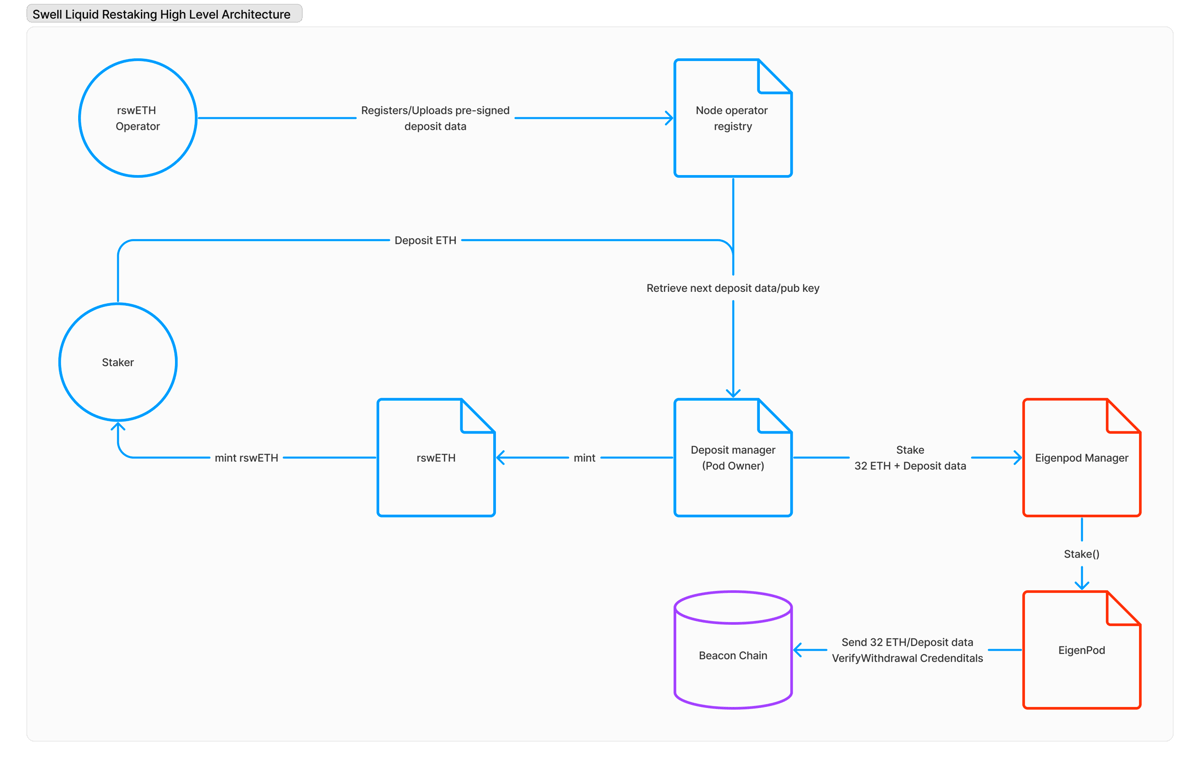
- rswETH: rswETH is an ERC-20 Liquid Restaking Token that enables users to restake ETH into protocols like EigenLayer without locking their ETH. It provides liquidity and represents yield-bearing ETH utilized for Ethereum transaction validation.
- rswETH v1.0 System Design: Built on the swETH framework and integrated with EigenLayer’s restaking protocol, rswETH handles deposits and withdrawals while rewarding restakers with EigenLayer points. It mirrors swETH’s operations, including node management, staking, repricing, and reward distribution.
- High-Level Architecture: Restaking Deposit Manager manages the creation and operation of the EigenPod, verifies withdrawal credentials, deposits 32 ETH into the Beacon Chain, and transfers rewards from the EigenPod to the restaking pool.
- Withdrawal Process: Withdrawals are conducted at the market rate through the Swell app.
- Waiting Periods
- EigenLayer Delays: Withdrawals may take up to 7 days due to native restaking processes.
- Beacon Chain Exit Queue: Variable waiting times depending on validator exit limits.
- Validator Sweep State: Up to 9 days if synchronized with validator sweep schedules.
- Buffer Dynamics: Large withdrawals may exceed Swell’s reward buffer, leading to potential delays.
- Secondary Market Swapping: rswETH can be swapped on secondary markets using decentralized exchanges (DEXs) or aggregators. This method allows for greater liquidity and flexibility in trading rswETH. However, users should be aware of potential slippage and differences in rates compared to the primary market rate, which could affect the final transaction value.
- Rewards and Fees (Updated 26.01.2024): The distribution of rewards from rswETH is allocated as follows:
- AVS Selection Framework: Developed by Gauntlet, this framework is designed to carefully select Actively Validated Services (AVSs) based on their risk profiles and potential returns. The goal is to minimize risks while maximizing returns for users and ensuring that selected AVSs positively contribute to the overall network performance and stability.
- Node Operator Set: Node operators play a crucial role in maintaining the stability, security, and decentralization of the network. They are responsible for keeping nodes stable, secure, and up-to-date with software. Additionally, they participate in community decision-making processes and help uphold decentralization principles. The network is working to expand the Node Operator set to further enhance robustness and reliability.
- Swell’s Ecosystem Integration: Swell L2 integrates with the Aggregation Layer to facilitate unified liquidity and secure native bridging between chains. By using a ZK-Validium approach, Swell reduces fee disparities between ZK Rollups and Optimistic Rollups through alternative data availability solutions like EigenDA. This integration supports the development of dynamic and secure dApps, enhancing the functionality and security of the Swell L2 ecosystem.
- Swell’s Restaking Mechanism: Swell’s restaking mechanism offers a flexible and liquid approach to staking ETH. It allows users to earn rewards without locking their assets, providing both security and liquidity. This mechanism ensures that users can participate in restaking activities while maintaining the ability to access and utilize their funds effectively.
Overview of Swell Liquid Restaking’s Restaking/Liquid Restaking Token —  swETH and
  swBTC
swBTC
swBTC
Key Features
- Non-Custodial: swBTC supports staking directly from users' own non-custodial wallets. This means that users retain control over their private keys and assets while participating in restaking, providing an added layer of security and personal control.
- Yield Generation: The yield earned from holding swBTC is generated through restaking protocols. Platforms like Symbiotic, Karak, and EigenLayer offer rewards for using WBTC as economic security, which translates into yield for swBTC holders. This allows users to benefit from the returns of these restaking systems without locking up their assets.
- Liquidity: swBTC can be used across a range of DeFi protocols. This flexibility means that holders can use swBTC as collateral in lending and borrowing platforms, trade it on DEXs, or engage in various financial strategies, enhancing their ability to earn additional yield.
- Audits: The security of swBTC has been validated through audits conducted by reputable firms such as Chainsecurity and Nethermind. These audits ensure that the smart contracts and system components of swBTC are secure and function as intended, providing users with confidence in the safety of their investments.
- Rewards: Swell offers rewards of up to $250,000 USD for the identification and reporting of vulnerabilities within its technology stack, ranging from smart contracts to websites and applications. This incentivizes security researchers to help maintain the integrity and safety of the swBTC system.
- Aera Vault: The Aera Vault serves as the central treasury management protocol for swBTC, enabling Gauntlet to act as the AVS Risk Guardian. This setup allows Gauntlet to manage the risk associated with restaking while optimizing returns for swBTC holders.
- Asset Registry: The Asset Registry defines which assets Gauntlet can interact with, ensuring that only approved tokens like WBTC and related derivatives are used. This mechanism prevents unauthorized swaps and maintains the security of the system.
- Hooks Module: The Hooks Module controls which function calls Gauntlet can execute, allowing the Swell DAO to limit Gauntlet's actions to those necessary for operating the vault. This provides an additional layer of security by restricting potential misuse.
- Direct Withdrawals: Users can withdraw swBTC at the primary market rate through the Swell app. Initial processing time for withdrawals is 3 days, which may extend as more swBTC is deployed into vaults with varying withdrawal delays.
- Secondary Market Swapping: swBTC holders can swap their tokens on secondary markets using DEXs or aggregators such as Curve or PancakeSwap. While this provides an option to bypass withdrawal wait times, the swap rate may differ from the primary market rate displayed on the Swell app.
swETH
swETH is intended to represent staked Ethereum (ETH) and facilitate the process of earning rewards through Swell’s staking mechanisms. It is a core component of the Swell staking system, enabling users to participate in Ethereum's proof-of-stake (PoS) consensus and benefit from associated rewards.
Users stake their ETH into the Swell ecosystem, and in return, they receive swETH tokens. These tokens represent both the staked ETH and the rewards accrued from staking. The swETH token thus acts as a receipt and claim on the staked assets and their returns. The conversion of ETH into swETH simplifies the staking process and integrates with Swell’s infrastructure, allowing users to easily manage and track their staked assets and rewards. Rewards are generated from participating in Ethereum’s PoS consensus mechanism. These rewards include block rewards, which are given for validating transactions and producing new blocks; priority fees, which are transaction fees paid by users to prioritize their transactions; and MEV (Maximum Extractable Value). The swETH token accumulates various types of rewards through staking, contributing to the overall return on investment for users.
- Integration: Within the Swell ecosystem, swETH plays a crucial role by serving as the token through which staking rewards are distributed and managed. It integrates seamlessly into Swell’s infrastructure, supporting the staking process and ensuring that rewards are efficiently allocated. swETH helps users participate in Ethereum staking without needing to manage their ETH directly.
- Swell DAO Treasury: A portion of the rewards generated from swETH staking is allocated to the Swell DAO Treasury. This allocation supports the governance and development of the Swell project, ensuring the sustainability and growth of the ecosystem. The Treasury uses these funds for project development, ecosystem growth, and other governance-related activities.
Features and Economic Model of swETH
- Non-Custodial: swETH allows users to maintain full control of their assets, reducing the risks associated with third-party custodial services.
- Flexibility: swETH provides liquidity to users by allowing them to participate in DeFi applications while their ETH remains staked. This means users can utilize their swETH tokens for lending, trading, or other decentralized financial activities, earning additional returns without needing to unstake their ETH.
- Security: swETH ensures a high level of security by working with vetted node operators and conducting continuous audits. This robust security framework helps safeguard user funds and maintains trust in the Swell ecosystem, providing a secure environment for staking and DeFi interactions.
- Reward Distribution: The economic model of swETH is designed to fairly compensate different stakeholders. Stakers receive 90% of the rewards generated from the staking process, node operators are rewarded with 5% for maintaining the system, and the Swell DAO Treasury receives 5%, which supports governance and further development of the ecosystem.
- Withdrawal Process: swETH holders can withdraw by swapping their tokens on secondary markets if they need liquidity without waiting for the official withdrawal process.