What is Allstake?
Allstake is an Omnichain Meshed Restaking protocol designed to extend restaking capabilities across multiple blockchains. It enables Actively Validated Services (AVS) or app chains to derive security from multiple assets simultaneously, rather than relying on a single blockchain’s native staking mechanism.
Key Features of Allstake
- Omnichain Capabilities: Interconnected Chains: Allstake provides a framework that connects various blockchains, allowing for restaking across different networks. This interconnectivity aims to enhance the security and functionality of multiple chains simultaneously.
- Modularization and Decoupling: Consensus and Execution Separation: The protocol separates consensus (agreement on state) from execution (processing transactions), allowing for more flexible and scalable solutions. This decoupling helps in optimizing both performance and security.
- Diverse Asset Utilization: Multi-Asset Support: Allstake supports a variety of assets beyond just Ethereum. This includes major cryptocurrencies like BTC, NEAR, and SOL, among others. Asset holders from different blockchains can utilize their tokens within the Allstake ecosystem to maximize returns.
- Enhanced Security and Risk Mitigation: Cross-Chain Security: By allowing restaking across multiple chains, Allstake aims to provide enhanced security. AVS and app chains benefit from a more diversified security model, potentially reducing risks associated with reliance on a single blockchain.
- Decentralized Operations: Allstake promotes decentralized operations by integrating multiple blockchains into a unified restaking framework. This supports the vision of a decentralized and interconnected blockchain ecosystem.
- Maximized Returns: Yield Optimization: Asset holders on both Ethereum and non-Ethereum blockchains can leverage the restaking mechanism to enhance their returns. The protocol’s design aims to optimize yield across different assets and chains.
The Allstake Architecture
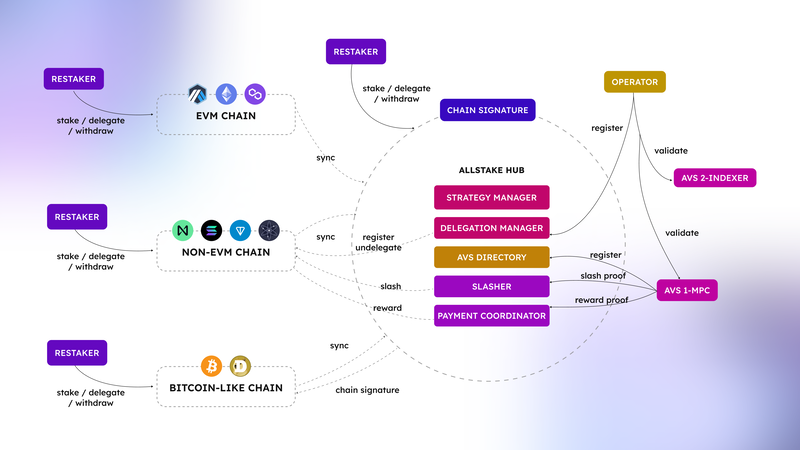
Allstake Architecture is designed to provide a robust and flexible framework for omnichain restaking, utilizing Chain Abstraction on NEAR Protocol. Here’s an in-depth look at the three core components of the Allstake Protocol:
- Allstake Hub: The Allstake Hub operates on the NEAR blockchain, leveraging its scalability and efficient consensus mechanisms. It serves as the central management system for the Allstake ecosystem. Oversees all Actively Validated Services (AVSs) and operators within the ecosystem. Monitors deposit, delegation, and withdrawal states of restakers. This ensures that all transactions and states are accurately recorded and managed. Also facilitates interactions and operations between different client chains and the overall restaking framework.
- Client Contracts: Client contracts are deployed on various client chains, including both EVM (Ethereum Virtual Machine) chains like Ethereum and non-EVM chains like Solana. Allow restakers to perform native staking, delegation, and withdrawal operations directly on their respective client chains. Since Bitcoin does not support smart contracts, Allstake uses Chain Signature logic to implement restaking functionalities. This involves off-chain mechanisms to manage staking and delegation activities.
- Cross-Chain Interoperability: Ensures that staking and delegation states from client chains are synchronized with the Allstake Hub. This helps maintain consistency across the ecosystem. Facilitates actions such as delegation, slashing, and reward distribution on client chains. These actions are executed via Chain Signature transactions initiated by the Allstake Hub, used for executing cross-chain transactions and managing staking operations across different blockchain networks.
How does Restaking Work on Allstake?
Allstake utilizes a process called restaking, which involves redeploying staked assets to enhance the security and functionality of various blockchain ecosystems. This method is crucial for securing cross-chain bridges, enabling omnichain exchanges, supporting shared sequencers, and facilitating decentralized intent solver networks. Here’s a breakdown of how restaking operates across these different use cases:
- Cross-Chain Bridge Security: Allstake's restaking mechanism enhances the security of cross-chain bridges by pooling resources and security guarantees from all participating chains. This is particularly beneficial for native asset bridges that require multi-asset liquidity. By allowing assets staked on one chain to be restaked on another, Allstake provides a diversified security model. This "meshed restaking" ensures that the bridges are secured by a broad base of validators and assets from various chains, increasing resilience against attacks.
- Omnichain Exchange: Omnichain exchanges often require secure off-chain orderbooks that can receive deposits from multiple chains. Allstake enables these exchanges to leverage the security from the chains they interact with by restaking assets across these networks. This setup enhances the overall security, performance, and user experience of the exchange, ensuring that cross-chain transactions are settled reliably and securely.
- VM-Agnostic Shared Sequencer: Sequencing and block building are critical in blockchain operations. Allstake supports a shared sequencer that operates across different chains and virtual machine (VM) environments. By restaking assets from various chains, Allstake ensures that these sequencers are highly secure and capable of handling transactions in a decentralized manner. This allows for consistent and fair transaction ordering, regardless of the underlying blockchain technology.
- Decentralized Intent Solver Network: A decentralized intent solver network allows users to interact with blockchains in a more abstract and user-friendly manner. Allstake's restaking capabilities enable intent solvers to operate securely across multiple chains. By leveraging the Chain Signature solution, these solvers can ensure that intents (user actions) are fulfilled accurately and securely. This infrastructure simplifies interactions with decentralized applications (dApps), promoting broader adoption of web3 technologies.
Key Components and Benefits
- Cross-Chain Interoperability: Restaked assets and security guarantees can be utilized across different blockchain networks.
- Chain Signature Solution: This feature secures cross-chain interactions and verifies the authenticity of transactions and intents.
- Decentralization and Security: Restaking distributes security responsibilities across a wide network of validators and assets, enhancing robustness against attacks.
- User-Friendly Interactions: By abstracting the complexities of blockchain transactions, Allstake makes it easier for users to engage with dApps and other blockchain-based services.


