
What is YieldNest?


Token migration is live.
YieldNest is an advanced liquid restaking protocol designed to simplify and optimize the process of restaking ETH through EigenLayer. It aims to make restaking accessible and manageable by providing users with a range of easy-to-understand, risk-adjusted restaking products.
Key Features and Benefits
- Simplicity: YieldNest abstracts the complexities of restaking by offering a straightforward, one-click solution. This eliminates the need for users to handle the intricate details of selecting operators or managing their investments. The protocol utilizes a sophisticated risk management system developed by LlamaRisk to carefully vet operators and Actively Validated Services (AVS). This helps mitigate risks such as slashing and ensures that users’ funds are safely managed.
- Liquidity: Unlike EigenLayer, which locks users' funds with a minimum withdrawal period of seven to ten days, YieldNest offers full liquidity. Users receive Native Liquid Restaking Tokens (nLRTs) and Liquid Restaking Tokens (LRTs) that represent their restaked assets. These tokens can be used across various decentralized finance (DeFi) protocols for trading, lending, or participating in liquidity mining programs.
- Controlled AVS Exposure: YieldNest provides controlled exposure to specific categories of AVS through nLRTs and LRTs. Users can choose to restake in isolated categories (e.g., rollups, AI, oracles) or diversified baskets of AVS.
The YieldNest Architecture
YieldNest operates within a multi-faceted ecosystem involving several key participants and stakeholders. Here’s an overview of the primary layers and their roles within the YieldNest project:
- Actively Validated Services (AVSs): AVSs are blockchain-based systems that leverage EigenLayer’s security to enhance their operations. They integrate with Ethereum’s consensus layer to boost security and efficiency. AVSs utilize restaked ETH and other tokens to validate transactions and operations. They establish slashing conditions and manage operational requirements, ensuring robust security and compliance.
- Restakers:Restakers contribute their ETH or ERC20 tokens to EigenLayer, supporting AVSs by providing validation and security. They engage in restaking activities, help secure AVS networks, and receive rewards for their contributions. Restakers rely on YieldNest to manage risks and select reputable AVS options.
- Node Operators: Node Operators execute essential tasks for AVSs, including transaction validation and consensus participation. They restake assets on EigenLayer and perform operations crucial to the AVS’s functionality. Node Operators are subject to slashing conditions if they fail to meet the AVS’s requirements.
- YieldNest Risk Management Team: This team is responsible for selecting and vetting AVSs and node operators, managing risk, and ensuring high-quality operator and AVS selections. They conduct thorough risk assessments, implement risk management frameworks, and provide insights into AVS and node operator evaluations. Their work involves ongoing analysis and refinement of risk strategies.
- Governance Forum and DAO Members: The governance forum and DAO (Decentralized Autonomous Organization) members are involved in decision-making processes and oversight of AVS and node operator selections. They review detailed reports, participate in discussions about AVS onboarding, and make collective decisions about protocol integration and risk management.
- DeFi Protocols: DeFi protocols interact with YieldNest by utilizing the liquid restaking tokens (nLRTs and LRTs) generated by YieldNest. They provide platforms for trading, lending, and liquidity mining using YieldNest’s tokens, which in turn supports the liquidity and usability of restaked assets.
How does Restaking Work on YieldNest?
YieldNest integrates with  EigenLayer to provide a seamless restaking experience, enhancing both liquidity and yield for users.
Restaking Methods
- Native Restaking: Users set their Ethereum validator withdrawal credentials to EigenPod, a smart contract on EigenLayer. Requires a minimum of 32 ETH and technical knowledge to run an Ethereum validator. Earns additional rewards from AVSs and Ethereum staking.
- ERC20 Token Restaking: Users deposit ERC20 tokens into EigenLayer’s protocol. Does not require running a validator or holding a minimum of 32 ETH. Generates rewards from AVSs based on the tokens staked.
Process Flow of the Restaking Process on YieldNest
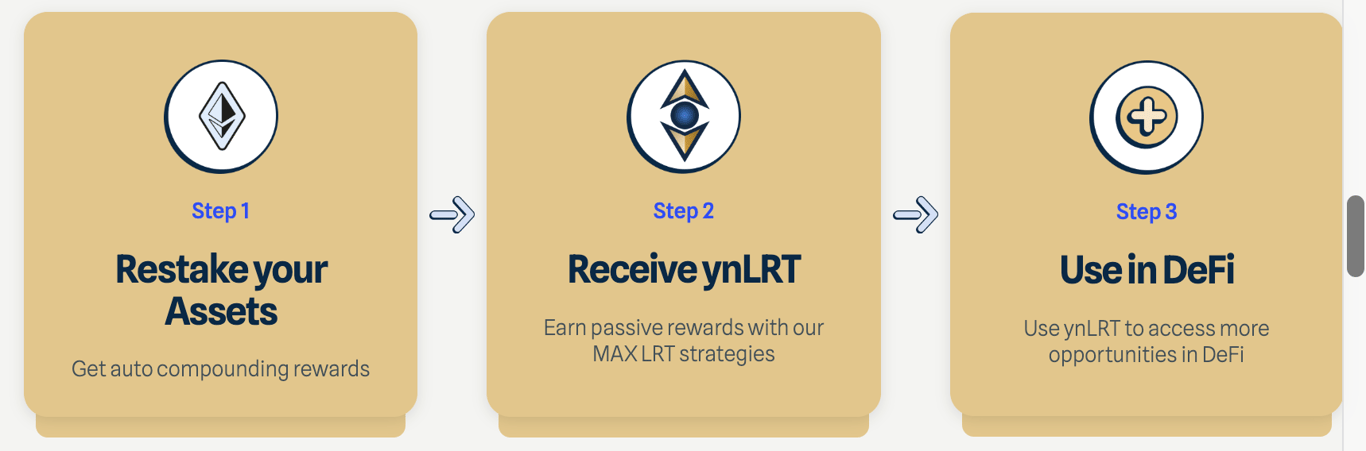
- Deposit: Users deposit ETH or ERC20 tokens into YieldNest’s liquid restaking protocol. In return, they receive nLRTs or LRTs, which represent their restaked assets.
- Earning Yield: Users earn Ethereum staking rewards and AVS rewards through their nLRTs. Users earn AVS rewards on top of any yield generated by the restaked ERC20 tokens.
- Liquidity and Trading: Users can trade nLRTs or LRTs on decentralized exchanges. These tokens can also be used as collateral or lent out on decentralized money markets, providing additional flexibility and yield opportunities.
- Withdrawal: While restaked ETH and ERC20 tokens are subject to a minimum withdrawal period of 7-10 days, nLRTs and LRTs offer liquidity without waiting, enabling users to quickly access their assets.
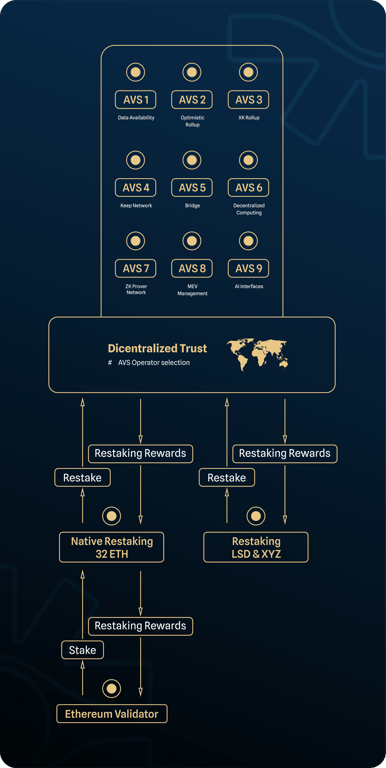
Overview of YieldNest’s Restaking/Liquid Restaking Token —  ynETH |
  ynLSDE
YieldNest is designed to optimize restaking returns while incorporating a robust tokenomic model that aligns stakeholder interests and ensures ecosystem sustainability.
ynETH
When users deposit ETH into YieldNest’s restaking pool, they receive ynETH, which acts as a liquid and tradable token representing their staked ETH. The rewards from restaking are distributed automatically to ynETH holders, veYND tokens, and the AVS operators.
The annual percentage yield (APY) for ynETH is composed of three main sources: Ethereum staking yield, AVS-generated yield and Airdrops
Although ynETH is not a rebasing token (meaning the amount of ynETH held doesn’t change over time), its underlying value increases as rewards are accumulated and compounded on-chain. For example, assuming a 12.5% APY, 1 ynETH could increase in value as follows: Day 0: 1 ynETH = 1 ETH, Day 180: 1 ynETH = 1.0625 ETH and Day 365: 1 ynETH = 1.125 ETH
This model allows ynETH holders to see their tokens grow in value over time, providing them with a steady, compounding yield.
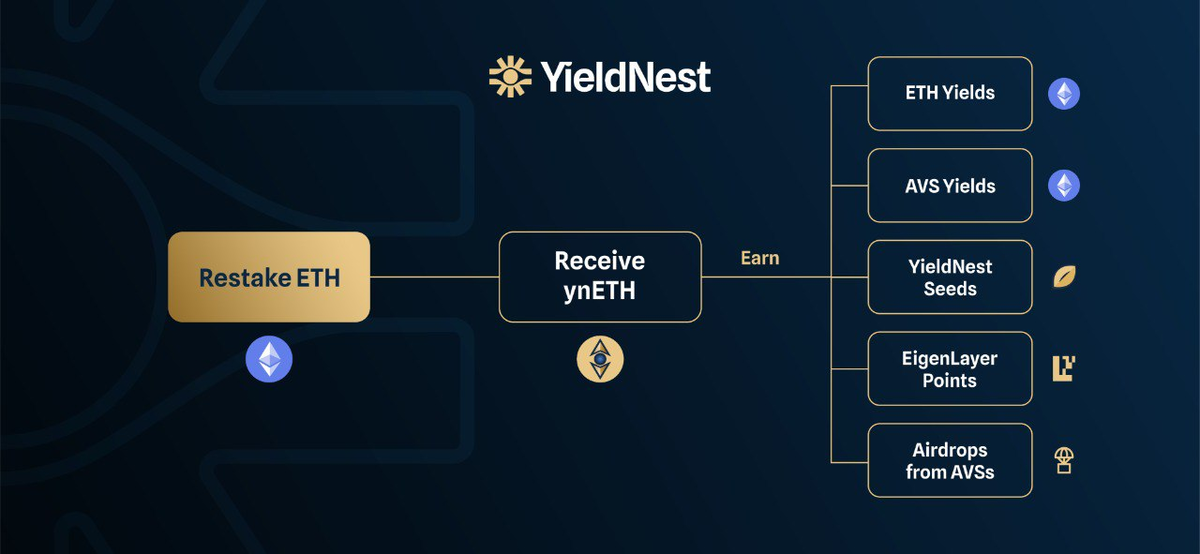
ynETH Use Cases
- Controlled Exposure: Holding ynETH gives users the ability to earn boosted yields by restaking ETH into a carefully selected and vetted basket of AVS categories, providing diversified exposure through a single liquid token.
- Providing Liquidity: Users can utilize ynETH to provide liquidity on external DeFi platforms, such as Curve, in ynETH-supported pools, earning additional income from swap fees and liquidity mining.
- Lending and Borrowing: ynETH can be lent or used as collateral on decentralized money markets like Aave or Euler. Users can also borrow ETH or stablecoins against their ynETH, with the option to leverage by borrowing ETH, restaking it into YieldNest, and acquiring more ynETH.
- Realizing Restaking Profits: Holders can withdraw ynETH for the underlying ETH and accumulated restaking revenue from AVSs on YieldNest, or they can swap ynETH for ETH or other similar assets on decentralized exchanges like Curve.
ynLSDE
At its core, ynLSDe is built on ynEIGEN, an open-source and flexible platform for EigenLayer. This allows it to manage a wide variety of assets, including LSTs, as well as LP tokens, stablecoins, and more. ynLSDe gives users the opportunity to accumulate yield from multiple sources while keeping their assets available for use in DeFi.
Users can restake their Liquid Staking Tokens from well-known platforms such as Lido (stETH, wstETH), Frax Finance (sfrxETH), Mantle (mETH), and Origin Protocol (OETH). By doing so, they can earn rewards from several sources, including ETH staking yields, restaking yields, EigenLayer Points, YieldNest Seeds, and potential future rewards from AVS categories and airdrops.
Additionally, ynLSDe ensures that staked assets remain liquid, enabling users to access higher yields while maintaining flexibility. The token's code is streamlined and secure, minimizing vulnerabilities and ensuring the safety of user funds. Overall, ynLSDe provides a powerful tool for users to enhance their yields in a secure and efficient way while keeping their assets functional in DeFi environments.
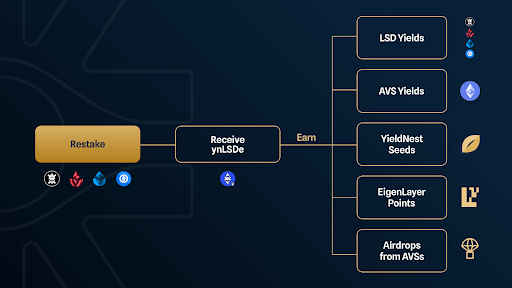
ynLSDe Use Cases
- Enhanced Yield: Restake LSTs to earn boosted yields through carefully managed AVS baskets.
- Controlled Exposure: Holding ynLSDe gives exposure to a vetted basket of AVS categories for optimized restaking returns, all with a single liquid token.
- Providing Liquidity: Use ynLSDe in external DeFi protocols like Curve to provide liquidity, earning swap fees and liquidity mining rewards.
- Lending/Borrowing: Users can lend or borrow against ynLSDe on decentralized money markets like Aave or Euler, using it as collateral to borrow ETH or stablecoins.
- Profit Realization: Users can withdraw ynLSDe for the underlying LSTs plus accumulated restaking revenue, or swap it for ETH on decentralized exchanges, allowing for profit realization without unstaking.