What is EtherFi?
EtherFi is a non-custodial, delegated staking protocol that allows users to stake their ETH while maintaining control over their private keys. This model aims to offer a higher level of security compared to traditional staking solutions. One of the unique aspects of EtherFi is its use of NFTs as staking receipts, which represent ownership and can be used to claim staking rewards. This approach enables liquidity and flexibility in staking, as these NFTs can potentially be traded or used within the DeFi ecosystem.
Key Features of EtherFi
- Non-Custodial Staking: Users retain control of their private keys, enhancing security and reducing the risk of centralized failures.
- Staking Receipts as NFTs: When users stake their ETH, they receive an NFT that serves as a receipt. This NFT can be used to claim rewards or potentially be traded in secondary markets.
- Restaking and Liquidity: EtherFi offers options for restaking, enabling users to maximize their returns. This includes the ability to participate in protocols like EigenLayer, which further boosts yields.
- EtherFan Program: This is a loyalty program designed to reward long-term stakers with additional benefits, including exclusive access and rewards based on staking duration and amounts.
The EtherFi Architecture
EtherFi is an Ethereum staking protocol that emphasizes decentralized and trustless solutions. The core of EtherFi's architecture revolves around three main components:
- Liquid Staking Mechanism: EtherFi allows users to stake their ETH and receive Liquid Staked Derivatives (LSDs) in return. These LSDs, represented by eETH, can be traded or used in various DeFi applications, providing liquidity and flexibility. The EtherFi protocol uses a two-layer approach: Liquid Staking Derivative Layer includes the issuance and management of LSDs like eETH. Users deposit ETH, which is staked in validator nodes. In return, they receive eETH, which represents their staked position and accrued rewards and the Staking Pool Layer manages the pooled ETH and allocates it to various validators. It also handles the distribution of staking rewards and any penalties incurred.
- Validator and Node Operator Structure: EtherFi leverages a decentralized network of node operators, who run validator nodes and secure the network. The platform employs Distributed Validator Technology (DVT) to enhance the security and reliability of staking operations. DVT splits the validator keys across multiple operators, preventing any single point of failure and reducing the risk of slashing. Node operators in the EtherFi ecosystem are rewarded with a share of the staking rewards and transaction fees. This incentivizes them to maintain high uptime and follow the protocol's guidelines.
- Security and Decentralization: Security is a fundamental aspect of EtherFi's design. The protocol uses smart contracts to manage staking, unstaking, and reward distribution, ensuring a trustless environment. It also incorporates mechanisms to mitigate risks, such as slashing conditions for misbehaving validators and insurance funds to cover potential losses.
How does Restaking Work on EtherFi?
Restaking on EtherFi utilizes a unique approach with its tokens, eETH and weETH, providing native restaking capabilities at the protocol level. Here's a breakdown of how it works:
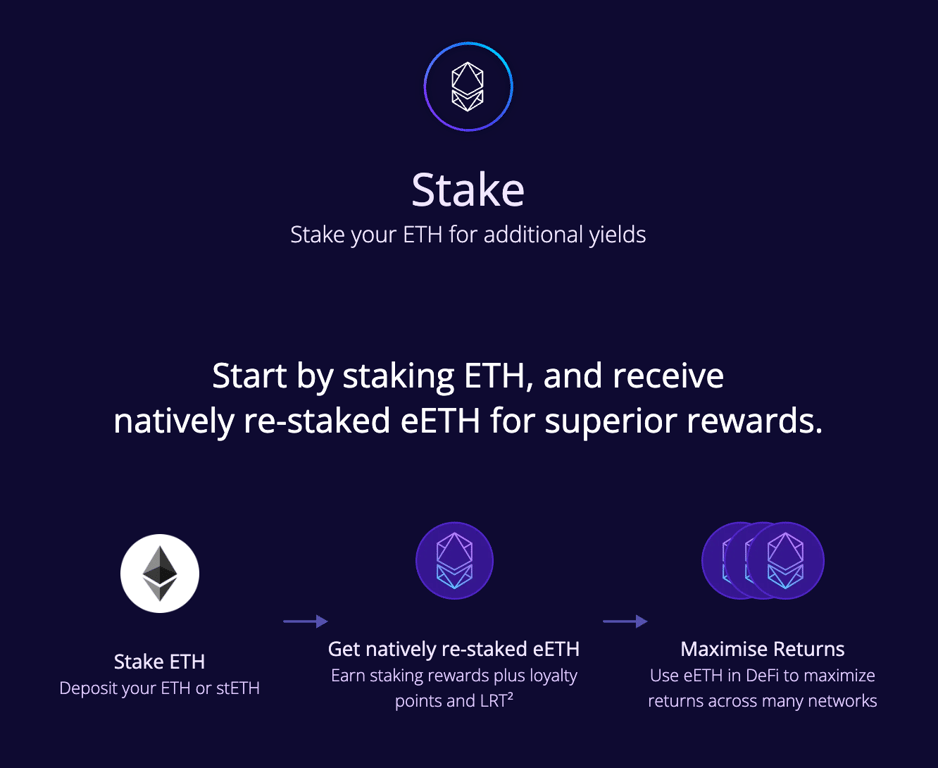
Key Concepts and Process
- Native ReStaking: eETH and weETH are the native restaked tokens on EtherFi. Unlike traditional liquid staking tokens (LSTs) like stETH, which require locking into contracts such as EigenLayer's Liquid ReStaking Strategy, eETH and weETH have restaking built directly into the protocol. By holding these tokens, users automatically participate in the restaking process and earn additional rewards without the need for separate actions or locking up assets. This integration simplifies the staking and restaking process.
- Earning Rewards: Users earn rewards based on the staked ETH amount and the protocol's staking yields. In addition to staking rewards, holding eETH/weETH also earns restaking rewards. These are derived from the natively restaked ETH at the protocol level, alongside potential EigenLayer points.
- Liquidity and Flexibility: eETH and weETH can be utilized within the broader DeFi ecosystem. Users can engage in various activities, such as providing liquidity, lending, or other DeFi strategies, while still benefiting from restaking rewards. Unlike conventional restaking strategies that might involve a 7-day withdrawal period, eETH and weETH offer more flexibility. Users can redeem their ETH without this waiting period, provided there is enough liquid ETH available in the contract.
Overview of EtherFi’s Restaking/Liquid Restaking Token —  eETH |
  eBTC |
  eUSD |
  weETHs | weETHk
EtherFi's Restaking and Liquid Restaking Tokens (LRTs) represent a cutting-edge suite of assets designed to simplify and enhance user participation in the growing restaking ecosystem. These tokens unlock innovative dual-yield opportunities, enable broader collateral utility, and seamlessly integrate with leading restaking platforms.
- eETH : EtherFi’s flagship liquid staked ether, optimized for restaking. Users earn staking and restaking yields while enjoying flexibility and utility within DeFi. Restaking is supported on Eigen Layer and Symbiotic.
- eBTC : A Bitcoin-backed LRT that combines staking and restaking yields. Powered by LBTC through a partnership with Lombard, eBTC offers users access to dual-yield Bitcoin opportunities via Eigen Layer, Symbiotic, and Karak.
- eUSD : A synthetic dollar LRT underpinned by USDe via Ethena. eUSD combines returns from Ethena’s tokenized basis trade and Eigen Layer restaking, providing a unique USD-denominated yield product for stablecoin holders.
- weETHs : The Super Symbiotic LRT tailored for the Symbiotic ecosystem. With broad deposit compatibility, including WETH, stETH variants, and more, users earn staking yield while accessing Symbiotic, ether.fi, and Veda points.
- weETHk : The King Karak LRT designed for seamless integration into the Karak ecosystem. Supporting diverse Ethereum staking assets, weETHk provides staking yield and point-based incentives through Karak, ether.fi, and Veda.


