

What is Euclid Finance?
Euclid Finance is designed to enhance the cryptoeconomic security of Ethereum by building on top of the EigenLayer protocol. EigenLayer introduces restaking, a novel cryptoeconomic security primitive that enables the reuse of ETH on the consensus layer. Euclid Finance aims to address the challenges associated with restaking, such as technical complexity, high entry barriers, and the risks of centralization, by offering a simplified and decentralized solution.
Key Features of Euclid Finance
- Restaking Simplification: Euclid simplifies the process of restaking ETH and liquid staking tokens (LST) on EigenLayer. Restakers no longer need to be tech-savvy or meet the high threshold of 32 ETH to participate. Euclid's decentralized validator network streamlines the process, allowing anyone to interact with its smart contracts, irrespective of the amount of ETH or LST they hold. This lowers the barrier to entry and makes restaking more accessible to a broader range of users.
- elETH: Omnichain Liquid Asset: Euclid introduces elETH, a liquid wrapper for restaked ETH or LST that acts as a yield-bearing asset. Restakers holding elETH can benefit from:
- Native ETH staking rewards.
- Additional restaking rewards.
- Diverse yield opportunities within the DeFi ecosystem.
- Risk Diversification: Euclid helps restakers diversify their positions within the EigenLayer Operators' network. By spreading their stakes across multiple operators, users can reduce the risks associated with single points of failure and potential centralization. This diversification is vital for minimizing the impact of any operator-related issues, such as slashing events, on the restakers' assets.
- Decentralized and Trustless Operator Network: Inspired by Rocket Pool, Euclid establishes a trustless and permissionless operator network. This design treats all operators equally, regardless of their size or influence, and lowers the barriers for them to join the network. Operators are required to stake Euclid's governance token, ECL, along with restaking ETH/LST as security deposits. These deposits ensure the operators' competence and commitment to the network. In case of slashing or malicious activities, the staked ECL serves as compensation for affected restakers.
- Security and Incentives: Euclid's architecture not only secures restakers' assets but also incentivizes operators to act responsibly. Operators earn rewards from both ECL staking and commissions from restakers who choose to delegate their assets. This dual incentive structure encourages the growth and sustainability of a decentralized operator network within the EigenLayer ecosystem.
- Focus on Omnichain and L2 Integration: Euclid places significant emphasis on creating an omnichain restaking liquid asset that supports Layer 2 solutions (L2s). This focus addresses the often-overlooked aspects of L2 integration, further expanding the reach and utility of Euclid's offerings within the broader Ethereum and DeFi ecosystems.
The Euclid Finance Architecture
The Euclid Finance project comprises several layers and key participants within its ecosystem, each playing a crucial role in enhancing the security, decentralization, and efficiency of the restaking process on EigenLayer.
Layers of the Euclid Finance Ecosystem
- Restaking Layer
This is the core layer where the restaking of ETH and Liquid Staking Tokens (LST) takes place. Users stake their assets through Euclid Finance, which then utilizes EigenLayer's smart contracts to extend cryptoeconomic security to various networks and applications.
- elETH Layer (Omnichain Liquid Asset Layer)
elETH is a yield-bearing liquid wrapper representing restaked ETH or LST in the Euclid ecosystem. This layer supports the creation and management of elETH, which provides restakers with multiple benefits, including native ETH staking rewards, additional restaking rewards, and diverse yield opportunities in the DeFi landscape.
- Operator Network Layer
This decentralized and permissionless layer comprises operators who manage the validator nodes within the EigenLayer network. Euclid Finance draws inspiration from Rocket Pool to create a trustless operator network, where all operators are treated equally. Operators must stake Euclid’s governance token (ECL) and restake ETH/LST as security deposits to participate. This layer is essential for ensuring the decentralization, security, and resilience of the Euclid ecosystem.
- Governance Layer (ECL Governance Token)
This layer governs the Euclid Finance ecosystem through the ECL token, which serves as the governance token. ECL holders participate in decision-making processes, such as protocol upgrades, parameter adjustments, and the selection of operators. Additionally, the staked ECL acts as collateral to compensate restakers in case of slashing or other malicious activities by operators, ensuring the ecosystem's integrity.
- DeFi Composability Layer (NGAD Member Protocol)
As part of the Next-Generation Asset Deployment (NGAD) initiative, this layer focuses on integrating Euclid Finance with various DeFi platforms to enhance composability. This layer rapidly builds and expands the elETH ecosystem, introducing new opportunities for yield generation and asset deployment within the broader DeFi space.
Participants in the Euclid Finance Ecosystem
- Restakers
These are users who stake their ETH or LST through Euclid Finance. Restakers are the primary beneficiaries of the ecosystem, earning rewards from native ETH staking, additional restaking incentives, and DeFi yield opportunities. They also contribute to the security and decentralization of the EigenLayer network by opting into diverse operator networks.
- Operators
Operators manage validator nodes within the EigenLayer network and are crucial for maintaining the network's decentralization and security. To join the Euclid operator network, operators must stake ECL tokens and restake ETH/LST as security deposits. In return, they earn commissions from restakers and rewards from ECL staking. Operators play a vital role in ensuring the robustness and reliability of the Euclid ecosystem.
- ECL Token Holders
These participants hold and stake the Euclid governance token (ECL) to take part in the protocol's governance. ECL holders have voting rights on key decisions, including protocol upgrades, operator selection, and other ecosystem governance matters. Their involvement is essential for maintaining the decentralized and community-driven nature of the Euclid Finance project.
- DeFi Integrators and Partners
These are external DeFi platforms and projects that integrate with Euclid Finance, enabling the composability of elETH across various protocols. DeFi integrators help expand the utility and yield opportunities for elETH holders, contributing to the growth and adoption of the Euclid ecosystem within the broader DeFi landscape.
- Actively Validated Services (AVS)
AVS are the services that borrow security from operators via EigenLayer. They benefit from the decentralized security provided by the Euclid operator network.
The Tranched Delegation framework helps AVS minimize the risk of operator collusion and enhances the decentralization of the network.
How Does Restaking Work on Euclid Finance?
The Euclid Finance restaking process is designed to offer a secure, efficient, and decentralized solution that builds on the EigenLayer protocol.
- Restaking on EigenLayer: Euclid Finance allows users to restake their ETH or Liquid Staking Tokens (LST) through EigenLayer. This process involves users opting into EigenLayer's smart contracts, enabling their staked assets to provide crypto-economic security to various services and applications on the network. By participating in restaking, users earn additional rewards beyond the native ETH staking rewards.
- No Entry Barrier to ETH Restaking: Unlike traditional staking on Ethereum, which typically requires a minimum of 32 ETH, Euclid Finance lowers the entry barrier. Users can convert any amount of ETH into elETH (Euclid's liquid restaking token) and participate in restaking without the need to meet this threshold. This feature democratizes access to restaking, making it accessible to a broader range of participants.
- Omnichain Liquid Restake Asset (elETH): Euclid introduces elETH, a yield-bearing liquid wrapper representing restaked ETH or LST. This token provides restakers with the flexibility to leverage the efficiency and cost-effectiveness of various networks beyond Ethereum Mainnet. It also ensures that users benefit from the staking rewards and additional restaking incentives while maintaining liquidity.
- Cross-Chain Restaking: Euclid Finance supports cross-chain restaking, allowing users to interact with and benefit from the efficiencies of other blockchain networks without direct reliance on the Ethereum Mainnet. This feature enhances the utility and versatility of the restaking process, providing users with a more diversified and potentially more profitable staking experience.
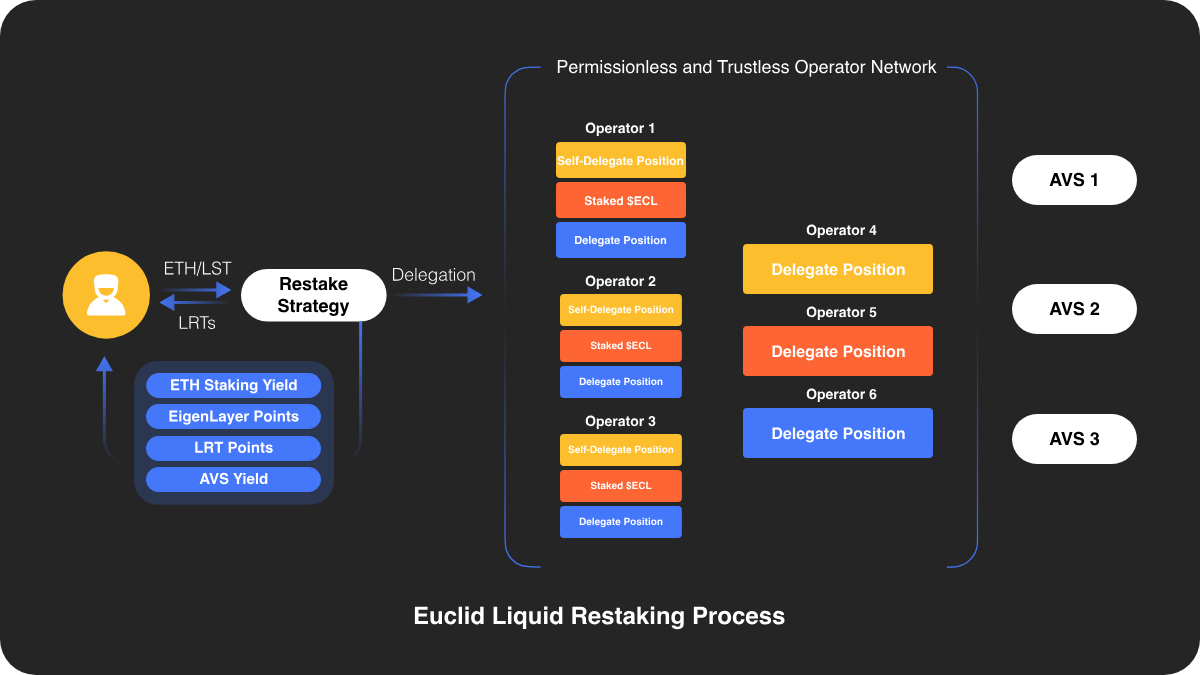
Overview of Restake Finance’s Restaking/Liquid Restaking Token —  elETH
elETH
To acquire elETH, users can restake through Euclid Finance or purchase it on secondary markets. elETH can be redeemed for ETH or the original LST staked, subject to a redemption window defined by EigenLayer.