
What is Karak?
Karak is a universal restaking layer designed to enhance cryptoeconomic security using any asset.
It provides developers with the means to create innovative infrastructure designs that are both seamless and secure. By enabling protocols to leverage robust and secure trust networks from the outset.
Karak significantly lowers the barriers to securing new protocols. This eliminates the need for these protocols to incentivize their own validator sets with highly dilutive reward mechanisms, making the process of bootstrapping security more scalable, accessible, and affordable.
Karak functions as a marketplace where developers can incentivize validators to allocate their restaked assets to secure their services. This is a significant improvement over the traditional method of issuing highly inflationary tokens as rewards for validators and establishing a new trust network from scratch.
With Karak, developers can attract validators to their projects through simple, non-dilutive incentives, reducing the financial and temporal investment required to build a new trust network.
Karak's universal restaking facilitates enhanced bootstrapping and composability across various networks. Despite the varying staking parameters of different blockchains, introducing a multi-asset restaking approach can help standardize these capital requirements.
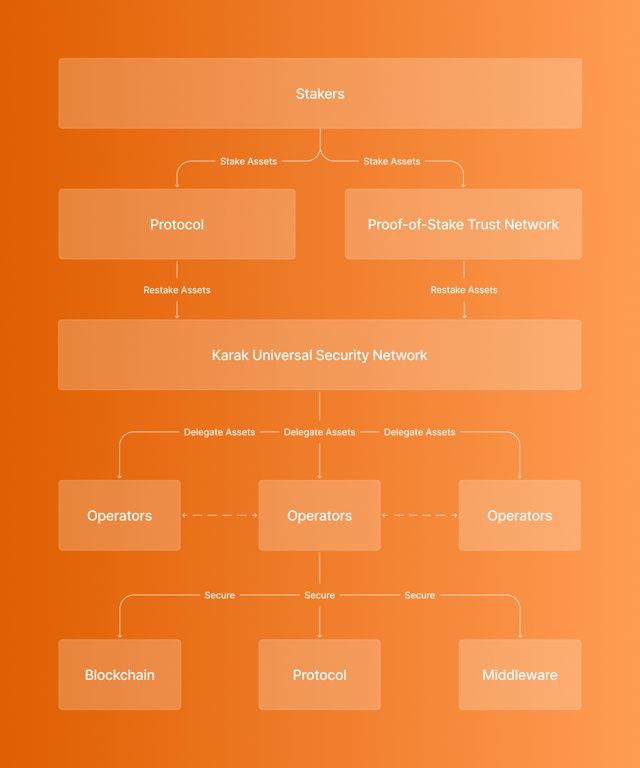
The Karak Architecture
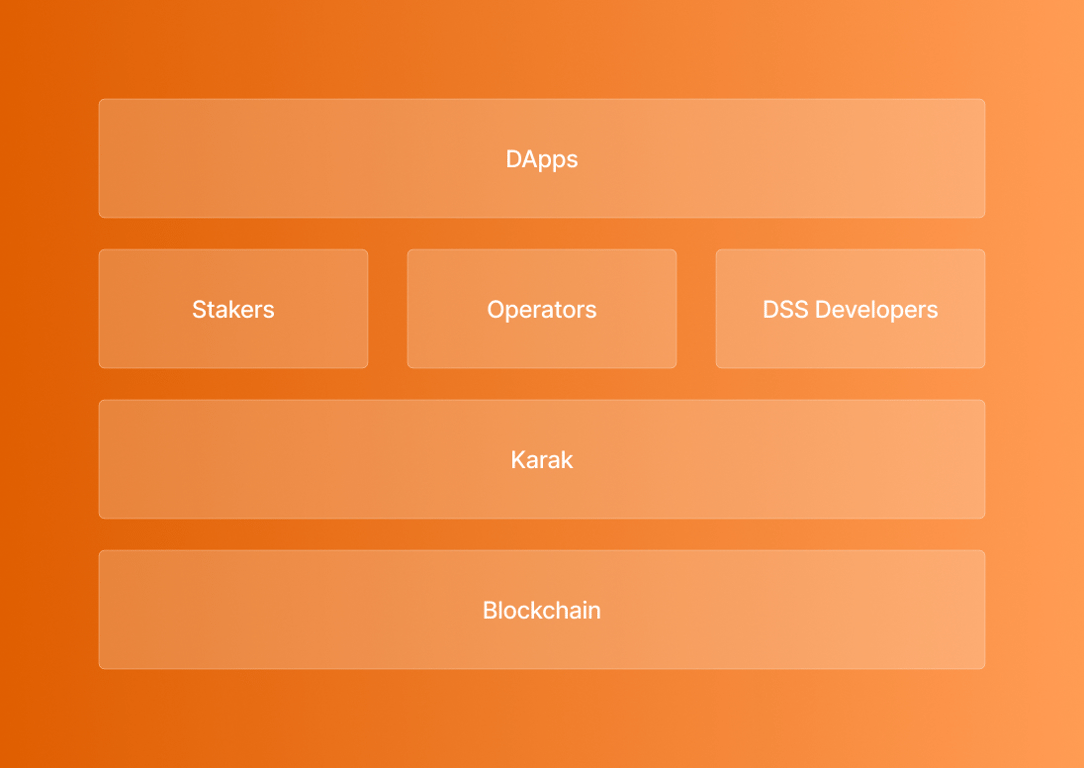
The Karak Network comprises several layers and key participants/stakeholders who play vital roles in ensuring the ecosystem's functionality, security, and growth. These participants include Restakers, Distributed Secure Services (DSS), Chains, Operators, and Developers. Below is an accurate description of each layer and the roles of these stakeholders:
- Restakers: Restakers are individuals or entities that contribute their staked assets to the Karak network to enhance its security. They play a crucial role in providing crypto-economic security across multiple blockchains. Restakers can allocate various types of assets, such as Ethereum, liquid staking tokens (LSTs), stablecoins, and more, to Distributed Secure Services (DSS) on the Karak network. They earn rewards for their participation, which can include boosted yields and network fees, on top of the native utility of their assets.
- Distributed Secure Services (DSS): DSS are services that utilize the restaked assets to enhance their security while reducing operational expenses. They include protocols such as data availability services, bridges, oracles, and more. DSS can become economically self-sustaining by leveraging multi-asset restaking, avoiding the need to issue highly inflationary rewards. They benefit from the additional slashing conditions agreed upon by restakers, which enforce participant integrity and ensure the security of the applications using Karak.
- Operators: Operators are individuals or organizations responsible for performing essential validation and security tasks for the DSS. Operators run validation software on Karak, enabling them to secure multiple networks with various assets, thereby maximizing capital efficiency with minimal overhead.
- Chains: Chains or rollups are blockchain networks that leverage the security services provided by DSS. They are an integral part of the ecosystem as they rely on DSS for enhanced security and operational efficiency. K2 is a risk management Layer 2 (L2) built on top of Karak. It utilizes the services provided by DSS, allowing for cost-effective and secure operations compared to performing activities on the main Ethereum Layer 1 (L1).
- Developers: Developers are builders who create and deploy new, unique services on the Karak network. Karak provides developers with a suite of tools and SDKs, making it easy for them to extend or create new functionality for their applications.
How Restaking on Karak Works
- Accessing the Platform: Users access Karak through its app, connect their wallet, and navigate to the restaking section.
- Depositing Assets: Users select the asset they wish to restake, enter the amount, approve the transaction, and complete the deposit.
- Earning Rewards: Once the deposit is confirmed, users start earning rewards on their restaked assets. They can monitor their progress and share referral codes to invite others.
Key Features of Karak
- User Engagement: Users who already have staked assets (like Ethereum, liquid staking tokens, or stablecoins) can participate in restaking by allocating these assets to Karak’s Distributed Secure Services (DSS). Users can restake through liquid staking tokens (LSTs) or stablecoins. For instance, they can deposit LSTs from protocols like Lido or Rocket Pool or stablecoins into Karak smart contracts.
- Allocating Assets: Stakers allocate their assets to a DSS on the Karak network. This involves depositing the selected assets into Karak’s smart contracts. Users agree to additional slashing conditions on their staked assets, which enforce participant integrity. These conditions ensure that the security of the applications utilizing Karak is maintained.
- Enhanced Security Mechanisms: These are rules that, if violated, can result in the loss of a portion of the staked assets. They are designed to uphold the integrity and security of the services provided by the DSS. The process enables the provision of cryptoeconomic security for various decentralized services, making it attractive for developers and validators to engage in the network.
- Marketplace Dynamics: Karak operates as a marketplace where developers incentivize validators to allocate their restaked assets to secure their services. This avoids the need for developers to issue their own tokens or establish new trust networks from scratch. Validators are attracted by non-dilutive incentives, significantly reducing the financial and temporal investment required to secure new protocols.
- Turnkey Development: Karak provides a suite of tools and SDKs that enable developers to easily create and deploy new, unique services secured by the network’s robust trust system. Developers can focus on building products and services with the assurance of inherent security from day one, leveraging Karak’s infrastructure.
- Handling Rewards and Withdrawals: Rewards are distributed by the DSS directly, with the LRT (Liquid Restaking Tokens) contract implementing functions to claim these rewards. Withdrawals on Karak are asynchronous, meaning users can request a withdrawal, which will be processed after a waiting period. The LRT vault contract manages these withdrawal requests through a queue.
- Operational Components: Individuals who contribute to the network’s universal security across Ethereum and other blockchains. Entities that perform essential validation and security tasks for the distributed secure services. Blockchain networks or rollups that leverage the services rendered by DSS.
- Distributed Secure Services (DSS): These services utilize the restaked assets to enhance their security while reducing operational expenses. Examples include data availability protocols, bridges, oracles, and more. DSS can become economically self-sustaining without needing to issue highly inflationary rewards, thanks to the flexibility of multi-asset restaking.