

What is ClayStack?
ClayStack is a decentralized liquid restaking protocol that operates on Ethereum. It is designed to provide a secure, scalable, and flexible staking experience by leveraging Distributed Validator Technology (DVT). The primary aim of ClayStack is to allow users to stake their ETH and participate in the Ethereum network's consensus mechanism while retaining liquidity and minimizing the barriers to becoming a validator.
Key Features of Claystack Restaking
- Modular DVT-Based System: ClayStack uses a Distributed Validator Technology (DVT) framework. This modular system enhances the security and decentralization of the protocol by distributing validator responsibilities across multiple entities. This mitigates the risks associated with individual validator failures.
- Native Restaking on EigenLayer: ClayStack integrates with EigenLayer, enabling users to restake their csETH for additional rewards. This native restaking feature ensures that users can maximize their returns without worrying about deposit caps.
- Transparent CLAY Point Redemption: Users earn CLAY points transparently, with the ability to redeem them at any time. This feature adds an additional layer of rewards, incentivizing active participation in the protocol.
- Validator Funding Provider (VFP) Initiative: The VFP initiative is a unique aspect of ClayStack, focusing on lowering the minimum capital requirements for running an Ethereum validator node. This democratizes access to staking and helps in the scalability of the network by enabling more participants to become validators.
- Instant ETH Withdrawal: Unlike traditional staking solutions that might have lock-up periods, ClayStack allows users to withdraw their ETH instantly, providing flexibility and ease of access to their funds.
- Liquid Restaking: Users can deposit their ETH into the ClayStack protocol and mint csETH, a liquid staking derivative. This allows users to earn staking rewards while maintaining liquidity, as csETH can be freely traded or used in other DeFi applications.
- Dynamic Points System: ClayStack introduces a dynamic points system that rewards users based on their staking activity. These points can be redeemed for CLAY, the protocol's native token, which can be used for governance or other purposes within the ecosystem.
How ClayStack Works
- Deposit ETH: Users start by depositing their ETH into the ClayStack protocol. Upon deposit, they receive csETH, representing their staked assets.
- Mint csETH: The deposited ETH is used to mint csETH, a liquid staking derivative that provides users with liquidity while their ETH is staked in the network.
- Earn Staking Rewards: As csETH holders, users continue to earn staking rewards generated from their staked ETH. These rewards accumulate automatically without requiring any further action from the user.
- Restake on EigenLayer: Users have the option to restake their csETH on EigenLayer, enabling them to earn additional rewards on top of the regular staking rewards. This process is seamless and can be done natively within the protocol.
- Validator Node Operation: Through the Validator Funding Provider (VFP) initiative, users can contribute to or operate Ethereum validator nodes with reduced capital requirements. This makes it easier for more participants to engage in network validation, enhancing decentralization.
- CLAY Points Accumulation: As users participate in staking and restaking activities, they accumulate CLAY points. These points are dynamically awarded based on activity levels and can be redeemed for CLAY tokens.
- Withdraw ETH: If a user wishes to exit the protocol, they can withdraw their ETH instantly by redeeming their csETH for the underlying ETH. This process is quick and user-friendly, ensuring that users have immediate access to their funds.
The ClayStack Architecture
ClayStack's Design combines a hybrid architecture with modularity and composability to provide flexibility, scalability, and customization.
There are 3 primary modules in Claystack’s architecture:
- DVT (Distributed Validator Technology)
- MEV (Maximal Extractable Value)
- Restaking
DVT (Distributed Validator Technology)
- Distributes validation responsibilities across multiple participants, enhancing security and decentralization.
- Integrates SSV (Secret Shared Validators) and Obol technologies for increased fault tolerance and decentralization.
- SSV Integration: Splits a validator's key among multiple entities, reducing single points of failure, promoting decentralization, and improving fault tolerance.
- Obol Integration: Enables large-scale decentralization by allowing multiple operators to collaboratively host and maintain infrastructure, enhancing system resilience.
MEV (Maximal Extractable Value) Layer
- Utilizes tools like MEV-Boost to maximize yields by optimizing transaction order within blocks.
- Benefits all participants by enhancing profitability within the ecosystem.
Restaking Layer
- csETH introduces restaking via EigenLayer, allowing holders to earn both EigenLayer and CLAY points.
- Native Restaking: ETH holders can deposit directly and mint csETH without limitations on the amount, earning rewards seamlessly.
- LST Restaking: Accepts liquid staking tokens (LSTs) like stETH, mETH, etc., to mint csETH and participate in restaking. This depends on EigenLayer caps for the respective LSTs.
- Re-stake Transfer: Allows existing restakers to transfer their position to ClayStack and continue earning dual rewards.
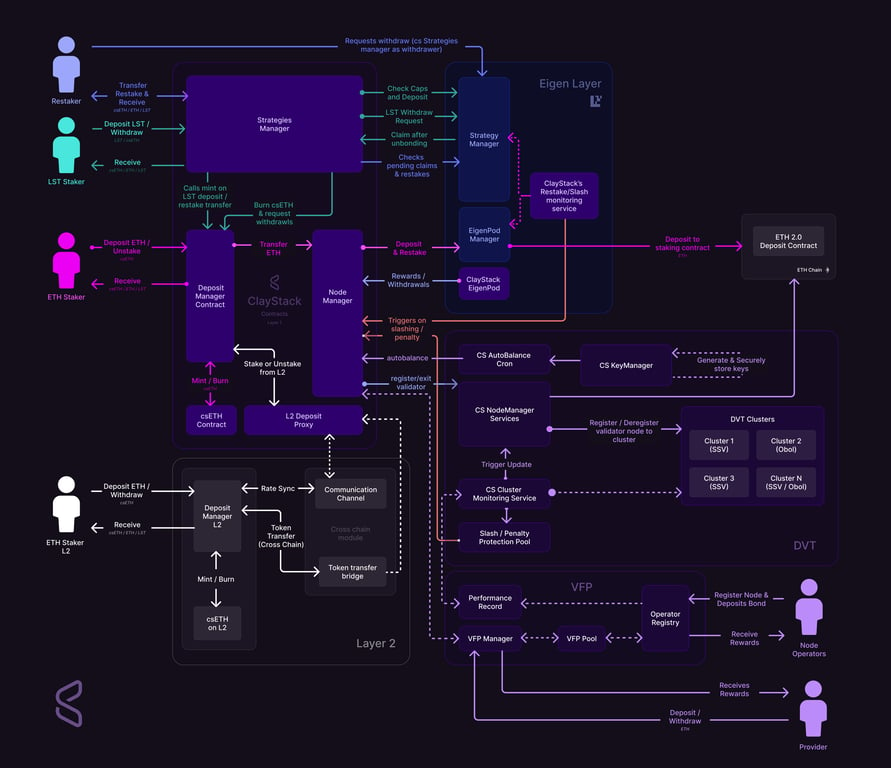
How does Restaking Work on ClayStack?
Restaking in the ClayStack project is a method by which users can enhance their staking experience by participating in additional staking activities beyond the primary Ethereum network. Here's a breakdown of how the restaking process works within ClayStack:
- Staking on ClayStack: Users deposit ETH or Liquid Staking Tokens (LSTs) such as stETH or rETH into the ClayStack protocol. Upon depositing, users receive csETH , a yield-bearing asset that represents their staked ETH. This asset accumulates native ETH staking rewards while also enabling further restaking activities, forming the foundation for enhanced yield opportunities.
- Restaking on EigenLayer: ClayStack is integrated with EigenLayer, an Ethereum-based restaking protocol. Through this integration, users' csETH is automatically restaked on EigenLayer using ClayStack’s smart contracts. This process is seamless, requiring no further action from users, and it allows them to earn additional rewards, such as EigenLayer points, contributing to the cryptoeconomic security of the network.
- Earning and Accumulating Points: Users earn multiple rewards during the restaking process. They accumulate CLAY points, which are distributed at a rate of 20 points per ETH per week. These points can be redeemed at a 1:1 ratio during the Token Generation Event (TGE). Additionally, users collect EigenLayer points, which are uncapped and earned based on their csETH holdings and the amount of ETH restaked. Alongside these, users continue to receive standard ETH staking rewards, which are automatically compounded into their csETH balance.
- Flexibility and Withdrawal: One of the key benefits of restaking with ClayStack is the instant withdrawal feature, allowing users to withdraw ETH at any time without facing lock-up periods. Furthermore, csETH remains unlocked, enabling users to deploy it across various DeFi protocols while still benefiting from the restaking process. This flexibility provides users with added opportunities to earn additional yield.
This approach to restaking on ClayStack offers an enhanced staking experience with flexible access to funds and opportunities for amplified returns.
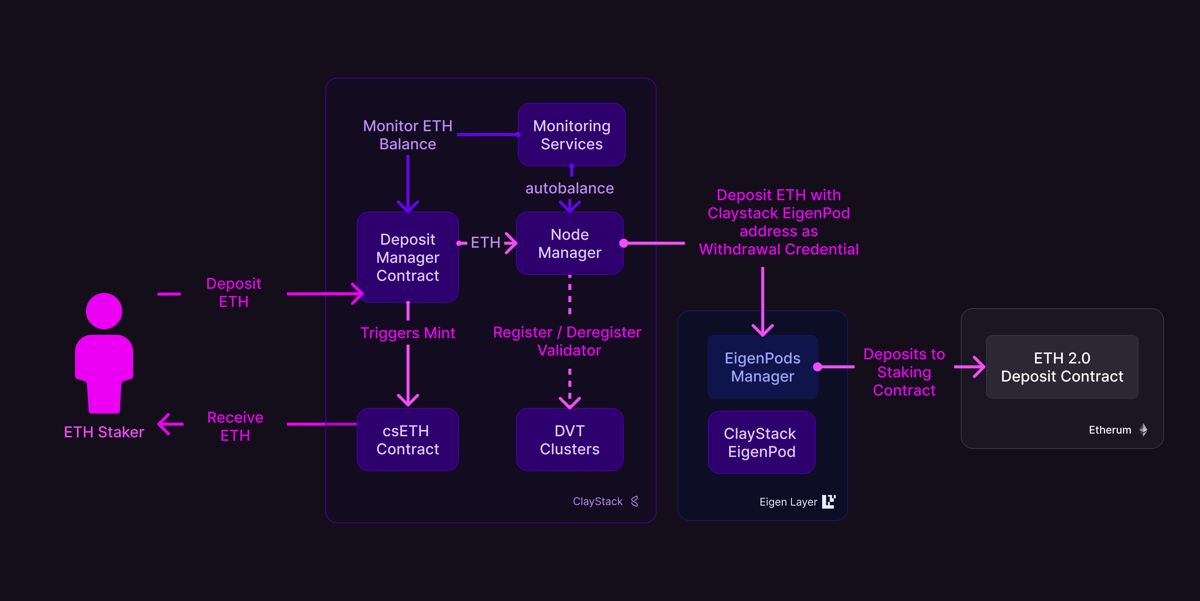
Overview of ClayStack’s Restaking/Liquid Restaking Token —  csETH
csETH
- Token Utility: The ClayStack token, often referred to as the governance token, plays a central role in the ClayStack ecosystem. It serves multiple functions, including governance, staking rewards, and as an incentive for network participants.
- Governance: Token holders have the power to participate in the governance of the ClayStack protocol. This includes voting on key decisions such as protocol upgrades, fee structures, and other important aspects that affect the operation and development of the ecosystem. This ensures that the protocol is community-driven and decentralized.
- Staking Rewards: The ClayStack token is also used to reward stakers who participate in the network. When users stake their tokens, they are rewarded with ClayStack tokens, which can be further staked or used within the ecosystem. This creates a cycle of staking and rewards, encouraging active participation.
- Incentive Mechanism: To ensure the network's security and stability, the ClayStack token acts as an incentive for validators and other network participants. By earning tokens, participants are motivated to contribute to the network's overall health and performance.
- Liquidity and Exchange: The ClayStack token is designed to be liquid, meaning it can be traded on various exchanges. This liquidity allows users to easily enter and exit their positions, making the token more accessible to a broader audience.
- Ecosystem Development: Funds generated through the issuance and circulation of the ClayStack token are often reinvested into the ecosystem. This includes funding for research and development, marketing, and other initiatives that aim to grow the ClayStack protocol and its community.