
What is Bedrock?
Bedrock is an advanced multi-asset liquid restaking protocol designed to enhance the staking and restaking experience across various blockchain networks. Developed in collaboration with RockX, a reputable blockchain infrastructure provider, Bedrock aims to offer a robust non-custodial solution for managing PoS (Proof of Stake) assets.
Bedrock’s core functionality revolves around its universal token model and its approach to liquid restaking. Here’s a breakdown of how it works:
- Liquid Restaking Tokens (LRT)
- Purpose: Bedrock issues LRTs for various assets, including wBTC, ETH, and IOTX. These tokens are designed to unlock liquidity and maximize the value of PoS assets.
- Mechanism: Users stake their assets through Bedrock’s protocol, which then issues corresponding LRTs (e.g., uniBTC, uniETH, uniIOTX). These tokens represent the staked assets and can be used in the broader crypto ecosystem.
- Universal Token Model
- Components
- Staked PoS Tokens: Represent the assets being staked on Bedrock.
- Future Staking Rewards: Capture all rewards generated from on-chain staking activities.
- Additional Points: Includes Babylon, EigenLayer, and Bedrock Diamond Points, which provide further value and incentives.
- Non-Rebasing Token Model
- Definition: The token model does not increase in quantity over time. Instead, the value of each token grows.
- Implication: Over time, 1 uniETH or uniIOTX becomes worth more than its equivalent in ETH or IOTX, in addition to accruing points from EigenLayer and Bedrock.
Supported Assets and Protocols on Bedrock
- uniBTC
- Overview: uniBTC is a liquid restaking protocol specifically designed for wrapped Bitcoin (wBTC) tokens. By integrating with the Babylon chain, which facilitates BTC staking, uniBTC aims to bring enhanced functionality and yield opportunities to BTC holders.
- Integration: The primary wrapped BTC token supported is wBTC on the Ethereum blockchain. This setup allows wBTC holders to enjoy the benefits of staking their BTC while benefiting from the security and infrastructure of Ethereum.
- Benefits: Stakeholders receive dual benefits: the staking yield from BTC and the added security and features of the Ethereum network. This creates a synergistic effect, leveraging Ethereum’s robust security to protect BTC investments.
- uniETH
- Overview: uniETH is designed for liquid staking of Ethereum (ETH). It harnesses additional rewards from the EigenLayer protocol, which provides extra incentives for participating in Ethereum’s staking ecosystem.
- Features: The protocol combines high-level security with increased yield. Institutional-grade security ensures that ETH staked via uniETH is protected against various risks while maximizing reward potential.
- Advantages: Users benefit from additional yield beyond traditional Ethereum staking rewards, thanks to the integration with EigenLayer.
- uniIOTX
- Overview: uniIOTX offers a liquid staking solution tailored for the IoTeX blockchain. It aims to address several limitations associated with Delegated Proof of Stake (DPoS) on IoTeX.
- Improvements: The protocol provides a more efficient and user-friendly experience for liquid staking, overcoming drawbacks typically associated with IoTeX’s DPoS model.
- Benefits: Stakeholders on the IoTeX blockchain can enjoy enhanced liquidity and staking efficiency, promoting a more dynamic and rewarding staking environment.
The Bedrock Architecture
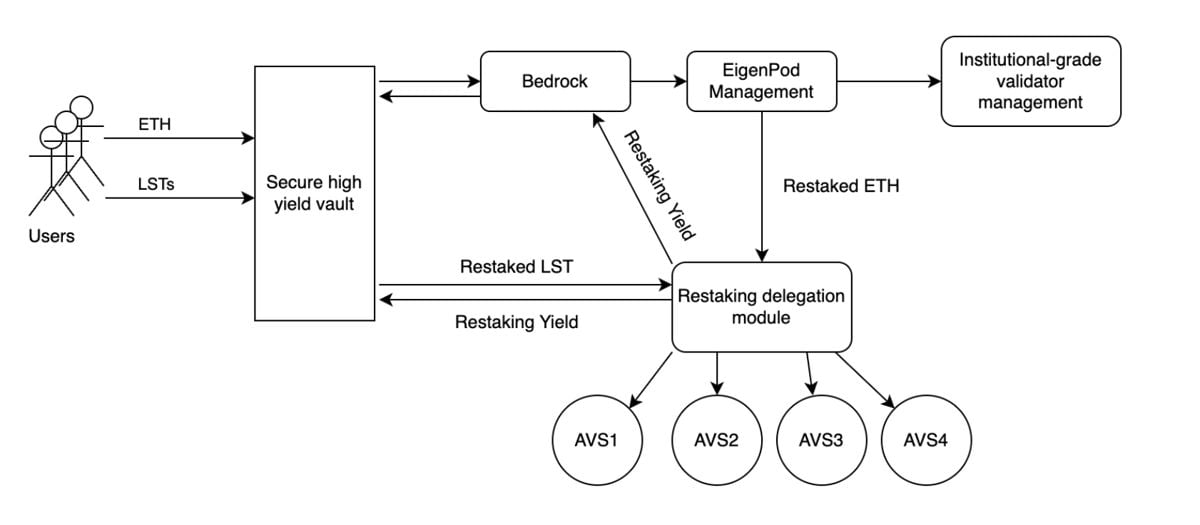
Bedrock integrates with  EigenLayer to provide a multi-asset liquid restaking protocol. The ecosystem comprisesseveral crucial components, each playing a distinct role in the overall functionality and value proposition of the Bedrock project.
EigenLayer serves as the backbone for Bedrock’s advanced restaking capabilities, and it consists of four main components:
- Actively Validated Services (AVS): AVS are decentralized services that leverage Ethereum's security through EigenLayer. They support various functionalities such as middleware, block building, and transaction ordering. AVS enhances Bedrock’s security by utilizing Ethereum’s pooled resources. This allows Bedrock to offer robust staking solutions for assets like BTC, ETH, and IOTX while tapping into innovative areas such as MEV (Maximal Extractable Value) and PBS (Proposer Builder Separation).
- Ethereum Stakers: Ethereum stakers restake their ETH to secure multiple networks. This provides additional yield opportunities but introduces a risk of slashing if the stakers do not meet the service conditions. Stakers in Bedrock can utilize their ETH to support Bedrock’s multi-asset restaking mechanisms. This not only helps in securing Bedrock’s assets but also in earning rewards from both Ethereum and Bedrock’s own staking operations.
- Node Operators: Node operators provide the computational resources necessary to run various services, including decentralized applications (dApps), oracles, and bridges. These operators play a key role in supporting Bedrock’s infrastructure by running essential services and ensuring the smooth operation of the protocol. They can choose which services to support and adhere to recommendations from AVS.
- Eigenlayer Protocol: The protocol consists of Ethereum smart contracts that facilitate interactions between stakers, node operators, and services. It allows Bedrock users to restake their assets, delegate them to node operators, and engage with on-chain service modules. These modules have conditions for rewards and slashing, ensuring a well-regulated environment for Bedrock’s operations.
How does Restaking Work on Bedrock?
Restaking has emerged as a transformative concept in the blockchain ecosystem, enabling users to earn additional yields on top of their existing Proof of Stake (PoS) returns. With the introduction of EigenLayer on Ethereum, restaking has quickly gained traction, with its market cap surging to over $4 billion in under a year. This process involves rehypothecating assets that are already securing a network to unlock incremental yield opportunities, enhancing the financial returns for stakers.
Bedrock leverages this concept to offer innovative solutions for generating extra yields through its Liquid Restaking Tokens (LRTs). Following the successful launch of uniETH, a Liquid Restaking Token integrated with EigenLayer on Ethereum, Bedrock is now expanding its offerings by introducing its first LRT with Babylon, a BTC staking protocol.
Bedrock utilizes EigenLayer to offer liquid restaking through its tokens, such as uniETH and the upcoming uniBTC. Here’s an overview of the restaking process and how it integrates with Bedrock’s ecosystem:
Non-Custodial Restaking
- Smart Contract Control: Bedrock employs the EigenPod Manager, a smart contract, to manage EigenPods. This ensures the system remains decentralized, reducing risks for uniETH holders by avoiding centralized points of failure.
- Flexibility and Upgradability: The system is built to adapt to changes in the EigenLayer protocol, allowing upgrades and new service integrations to happen smoothly. This ensures that uniETH holders won’t need to take any action during upgrades or changes.
- Announcement and Withdrawal: Bedrock will announce any transitions or upgrades well in advance, allowing uniETH holders ample time to withdraw their ETH if they choose to do so.
- Testing and Auditing: All smart contract modifications will undergo thorough testing and auditing to guarantee security and proper functionality before implementation.
- Anti-Slashing Measures: Bedrock will implement various risk mitigation techniques to protect users. One key method is scoring AVS operators based on metrics like Total Value Locked (TVL), uptime, and reputation. This helps ensure that only reliable operators are chosen, optimizing restaking yields while minimizing risks. Additionally, TVL caps will be enforced to limit the amount of restaking with any one AVS service, further managing risk and safeguarding user funds.
- Security Deposits: Bedrock will require AVS operators to contribute to a community fund, which serves as a protective measure for uniETH holders. In the event of slashing or other issues, this fund will be used to compensate users, adding an extra layer of security.
- Restaking Delegation Module: Bedrock will use this module to select and manage AVS operators. The module will focus on optimizing restaking strategies to maximize yield while ensuring the highest level of security for the users. This allows for seamless and efficient restaking operations, prioritizing both returns and safety.
Overview of Bedrock’s Restaking/Liquid Restaking Token —  uniBTC ,
  uniETH ,
  uniIOTX
uniBTC
Why uniBTC?
BTC holders have long awaited a solution that allows them to earn yields without sacrificing the security of their holdings. While Babylon’s Bitcoin Staking Protocol is designed to enable restaking on the BTC blockchain, it primarily focuses on native BTC. Bedrock's uniBTC offers an innovative solution for wBTC holders, enabling them to earn restaking rewards without needing to redeem their wBTC. This process maintains the high security standards of the Ethereum blockchain, with the entire staking and unstaking process secured by rigorously audited smart contracts.
Bedrock’s expertise in liquid staking and restaking products positions uniBTC as a highly attractive option for users of wrapped BTC tokens, offering them multiple rewards simply by minting uniBTC.
Staking Rewards Distribution
During the initial weeks of the Babylon mainnet launch, restaking rewards won't be available. However, the Bedrock team will incentivize wBTC holders to try out the restaking process and earn potential rewards and multiple points. The user experience is straightforward, and wBTC stakers can earn up to 21x booster Diamond points by staking wBTC into the Bedrock protocol.
Minimum Deposit
There is no minimum deposit required to earn rewards with Bedrock. However, to ensure transaction cost-effectiveness, a deposit of at least 0.005 wBTC is recommended. Upon staking wBTC, users will receive uniBTC, which represents their staked wBTC.
Staking Period for uniBTC
The staking period for uniBTC is determined by the Babylon blockchain, which imposes a lock period for BTC staking. Despite this, uniBTC will accumulate staking rewards over time, and can be traded or used for liquidity provision to earn additional yield.
Verifying uniBTC Supply and Deposits
- Total Supply: The total supply of uniBTC can be verified on-chain via Etherscan, as all contracts are open-source.
- Deposits: All deposits into uniBTC are captured by the deposit smart contract and can be checked on Etherscan.
Staking Process
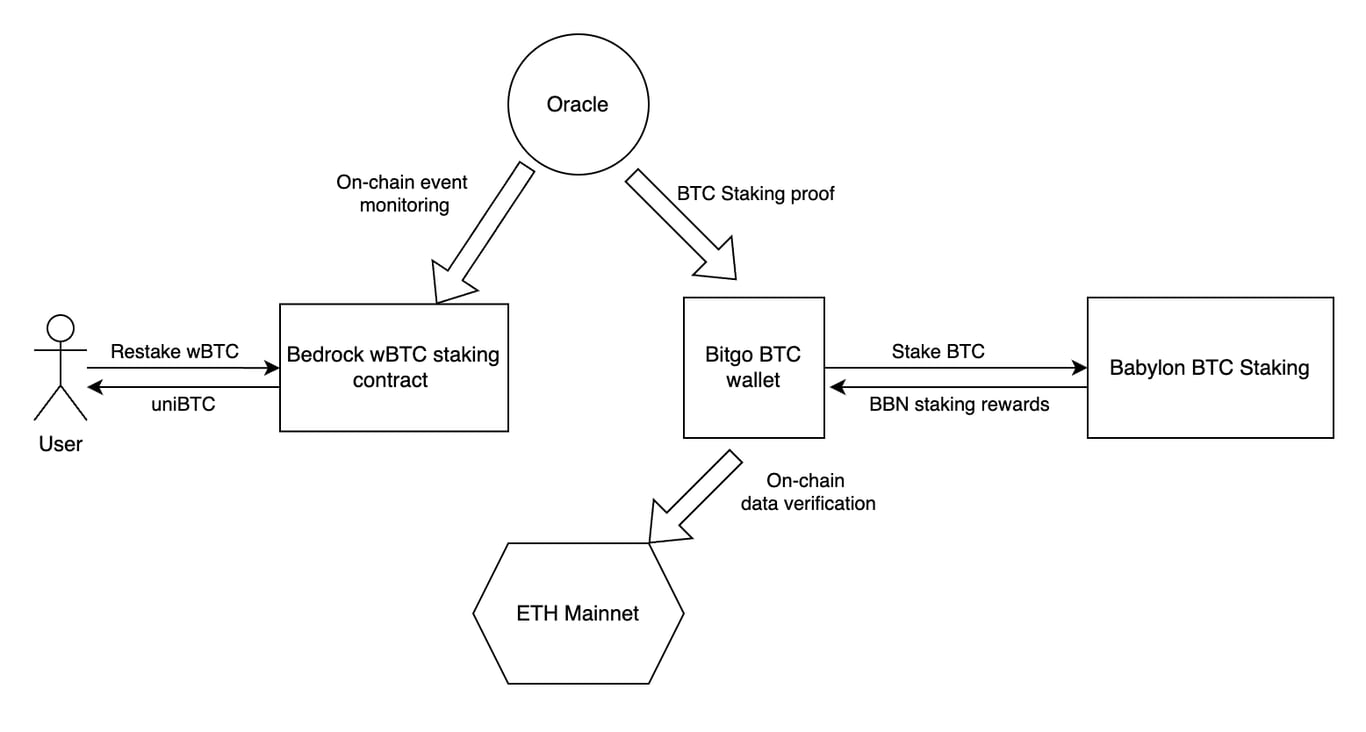
When wBTC is deposited into Bedrock, an equivalent BTC amount is staked to the Babylon network. This can happen through two approaches:
- Proxy Staking: wBTC is staked on Ethereum, and an equivalent amount of BTC is staked on Babylon by a trusted party. This method enables flexibility and interoperability between the Ethereum and Babylon networks.
- Direct Conversion: wBTC is instantly converted into BTC, which is then directly staked onto the Babylon network, offering seamless conversion without involving centralized custody.
Both approaches aim to ensure smooth and secure staking operations between the Ethereum and Babylon networks.
uniETH
Staking Process
- Connect Wallet: Click 'Connect Wallet' at the top of the dApp page to link your MetaMask to the platform.
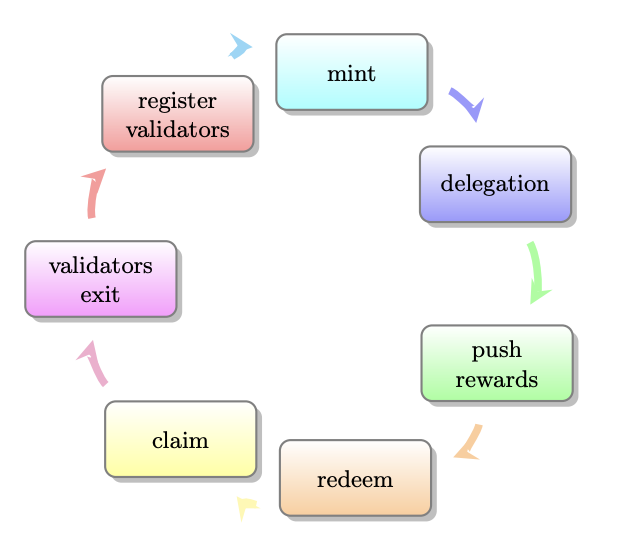
- Mint uniETH: Once your wallet is connected, the option to mint uniETH will become available. By depositing ETH, you will receive an equivalent amount of uniETH.
- Earning Rewards: uniETH accumulates staking rewards over time by increasing in token value, thanks to the performance of Bedrock's validator nodes on Ethereum.
- Trade and Liquidity: uniETH can be traded on various DEXs and CEXs, depending on liquidity availability. It can also be used to provide liquidity for additional yield opportunities.
- No Minimum Deposit: There is no minimum deposit required to use Bedrock. However, a deposit of at least 0.01 ETH is recommended to ensure the transaction is cost-effective.
- Add to MetaMask: To view your uniETH in your MetaMask wallet, click 'Add to MetaMask' to import the uniETH token.
Unstaking Process
- Dependent on Ethereum and EigenLayer: The time it takes to unstake uniETH is influenced by the Ethereum blockchain and the EigenLayer protocol.
- Unstaking Queue: Validators must wait in a single queue for both full and partial withdrawals. The waiting time is dictated by the Ethereum blockchain.
- EigenLayer Requirement: EigenLayer requires an additional 7 days to process the unstaking request, which adds to the overall waiting period.
Fee Mechanism
- Commission on Block Rewards, Transaction Fees, and MEV Fees: A 10% commission is applied to block rewards, transaction fees, and MEV (Miner Extractable Value) fees.
- EigenLayer Points: All EigenLayer points are distributed to uniETH holders with a 0% commission by the protocol.
- Restaking Fees: The commission on fees from restaking will be decided by the community at a future date.
uniOTX
How uniIOTX Works
- Reward Components: The rewards for uniIOTX come from three main sources:
- Block Reward
- Foundation Reward
- Epoch Reward
- Improved Staking Experience: Bedrock on the IoTeX blockchain addresses several issues associated with Delegated Proof of Stake on IOTX. By using Bedrock, all interactions with the IoTeX blockchain are handled on your behalf. Upon depositing IOTX, you instantly receive uniIOTX.
- Liquidity: uniIOTX can be traded, sold, or held at any time, offering users liquidity on their staked IOTX.
- No Minimum or Maximum Deposit: There is no minimum deposit requirement for staking IOTX with Bedrock, allowing everyone to participate. Although there is no maximum deposit limit, compliance checks will be conducted to prevent sanctioned wallet addresses from using the Bedrock protocol.
Staking Process
- Connect Wallet: Click 'Connect Wallet' at the top of the dApp page to link your MetaMask to the platform.
- Mint uniIOTX: Once connected, the option to mint uniIOTX will be available. By staking IOTX, you will receive uniIOTX, which increases in value as it accrues staking rewards.
- Add to MetaMask: To view your uniIOTX in your MetaMask wallet, click 'Add to MetaMask' to import the uniIOTX token.
Unstaking Process
- Unstake in Large Units: Unstaking uniIOTX must be done in units of 1 million IOTX.
- Processing Time: The unstaking process requires 94 days to unlock your staked IOTX.
- Claiming Unstaked Tokens: After the 94-day period, you can claim your unlocked IOTX by transferring it to your wallet.
- Rewards Accumulation: During the unstaking period, rewards continue to accumulate. You can claim these rewards at any time during or after the unstaking process.