

Introduction to DIA
DIA’s architecture focuses on maximizing decentralization and trustless execution. It is composed of state-of-the-art modular components that use Lasernet, DIA’s native Ethereum layer-2 rollup, as its core settlement layer for critical data operations such as computation and verification. DIA tackles traditional blockchain oracles’ issues through its rollup-powered architecture:- Independent nodes fetch data directly from sources (CEXs, DEXs, more)
- Data is submitted on-chain to DIA Lasernet – DIA’s ETH L2 rollup
- Processing and aggregation of data happen on-chain
- Transactions are settled on-chain transparently
Features
Crypto-economic security
Decentralized data sourcing by independent Feeder nodes, backed by staked assets.
Any asset from any chain
DIA’s first-party data sourcing capabilities one of its core benefit, enabling unlimited asset coverage.
Deploy anywhere, fast
Seamless data transmission to any chain significantly reduces time to market and friction in the developer UX.
Open and permissionless
Anyone can contribute to the system’s security or self-deploy and manage oracles contracts.
Full data transparency
From granular data sourcing to immutable processing trails, the stack ensures that everything is fully traceable.
No trust assumptions
Data computation happens on-chain via smart contracts, enabling full verifiability of the end-to-end process.
Data Flow: From Source to Feed
DIA is composed of three main stages, each critical to ensuring the accuracy, reliability, and accessibility of your data.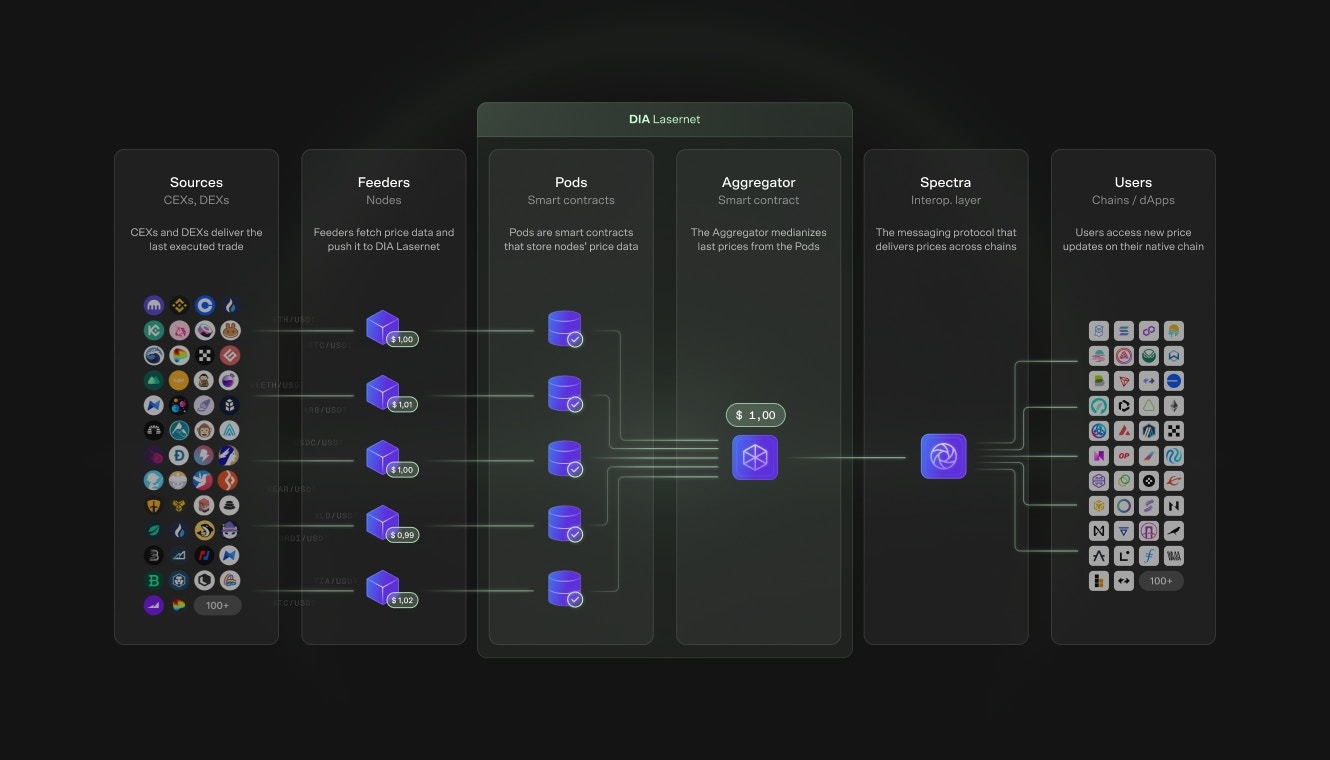
DIA stack's components
For a breakdown of each process, read the Architecture section.